Monday, 20 September 2010

A busy weekend - White-rumped sandpiper and King eider.

Oare Marshes, Kent.

On Friday I went to Oare marshes to see the white-rumped Sandpiper. I did see one last year at Abberton Reservoir (if seeing a tiny dot on the far side of the Reservoir counts). At Oare, the bird was much nearer, but it is a small bird so it's difficult to get a reasonable photo. It's actually smaller than a dunlin. When I arrived, one or 2 people were looking at a redstart in a bush near the road. I decided to get the Sandpiper in the bag first, so made my way to the sea path just beyond the sluice. The white-rumped Sandpiper was showing very well at a distance of 60 m or so. I watched it for a while and took some photographs before heading back to see the redstart.


White-rumped sandpiper.

The redstart was proving a little elusive but very entertaining. I hadn't had an opportunity of observing an adult redstart in action before. There was a lot of tail flicking of its gorgeous red (well, actually more orange than red) tail. It also pounced on insects on the ground.


Common redstart.

While watching the redstart it became apparent that the bush contained other birds as well. A gorgeous lesser whitethroat emerged to eat some berries, and it was joined shortly afterwards by a common whitethroat. I watched these birds for over an hour before going to scan the main flood.


Lesser whitethroat.

I was hoping to see little stints , but no luck. A large flock of golden plover flew in. There were half a dozen ruff, a common snipe, as well as the usual lapwings, black-tailed godwits, a couple of avocets, little egrets, teal, shoveller, cormorant, etc.


Golden plover.

Minsmere, Suffolk.

I started early on Saturday to go to Minsmere for the King eider, hoping to narrow David Campbell's lead in our British lists. The bird had been seen anywhere along a 3 or 4 mile stretch of coastline. I arrived at 8.15 but the centre didn't open until 09.00. I decided to go straight to the sluice where a couple of people were already on the bird. I had a quick look through their telescope in case it flew off before setting up my tripod. The eider was quite distant, over halfway to the horizon so these pictures of it are very poor.


King eider.

Having bagged the King eider, I walked further along the beach where some early birders were looking for 2 Lapland buntings. The sand and shingle area between the beach and the path was covered with large clumps of reed grass. One of the birdwatchers found a bunting which, although I couldn't see it, was clearly heading my way. I sat down on the beach, lowered my tripod and waited. A little later a very nice Lapland bunting appeared between the tufts and I was able to take a few photos. It was being stalked by several photographers now and it quickly disappeared again.


Lapland bunting.


One of the birdwatchers mentioned that a large flock of bearded tits was in the reeds by the sluice. I walked down with another birdwatcher and we came across the flock very quickly.


Bearded tits. Male above, female below.

They didn't stay long so we scanned the lake. My companion picked out a very strange looking hybrid goose, which looked like a cross between a barnacle goose and a Canada goose.


Hybrid goose. Probably Canada/barnacle.

After breakfast at the centre I walked around the reserve again. The king eider was still present in the afternoon. There was a single bar tailed godwit, a couple of avocets and a spotted redshank, but nothing else of note.

On the feeders back at the centre I noticed a great tit with a strange fleshy tube beneath its bill. It had a similar lesion on one of its wings. It was eating from the feeder so I hope it will live.


Deformed great tit.

Thursday, 16 September 2010

A lapland lifer today!

Getting up at 05.15 to get to Beddington Sewage Farm by 06.00 was hard, but worth it to get a lifer in a short while. Two birds were feeding in the long grass and, although not so confiding as with the first ones to see them yesterday, they were still not too bad. The grass got in the way of the autofocus but this shot is perhaps the best of the bunch. After taking some pictures I had to go to work!


Lapland
buntings

Saturday, 11 September 2010

Two British/life ticks are better than one!

After missing the Grove Ferry Wilson's phalarope yesterday, I went first for the Isabelline shrike at Gosport today. The weather was dull but the bird obliged on several occasions by coming out briefly. It was very like a brown shrike; just slightly paler.


Isabelline shrike


After that, I just had to return to Grove where the phalarope had been seen. As I arrived, the pager said it was on the water meadow so I made haste to there. AAhhh!! It had only stayed a few minutes and had flown. I decided to stay there as the habitat looked good. After an hour or so it was seen at Harrison's Drove hide, a good 15 mins walk. Off we set hoping it would stick around. Hot and out of breath I arrived and it was still there with a green sandpiper in the far corner of the lake. Yesterday, that lake had been teeming with birds. Today there were just two birds!! The reeds were just a little high to get a clear picture so I jumped onto the roof of the hide where I had clear line of sight but it was still 150-175metres distant. Thank you the couple who helped me up and down with my gear. This poor record shot is all I could get from that distance:


Wilson's
phalarope

Sunday, 5 September 2010

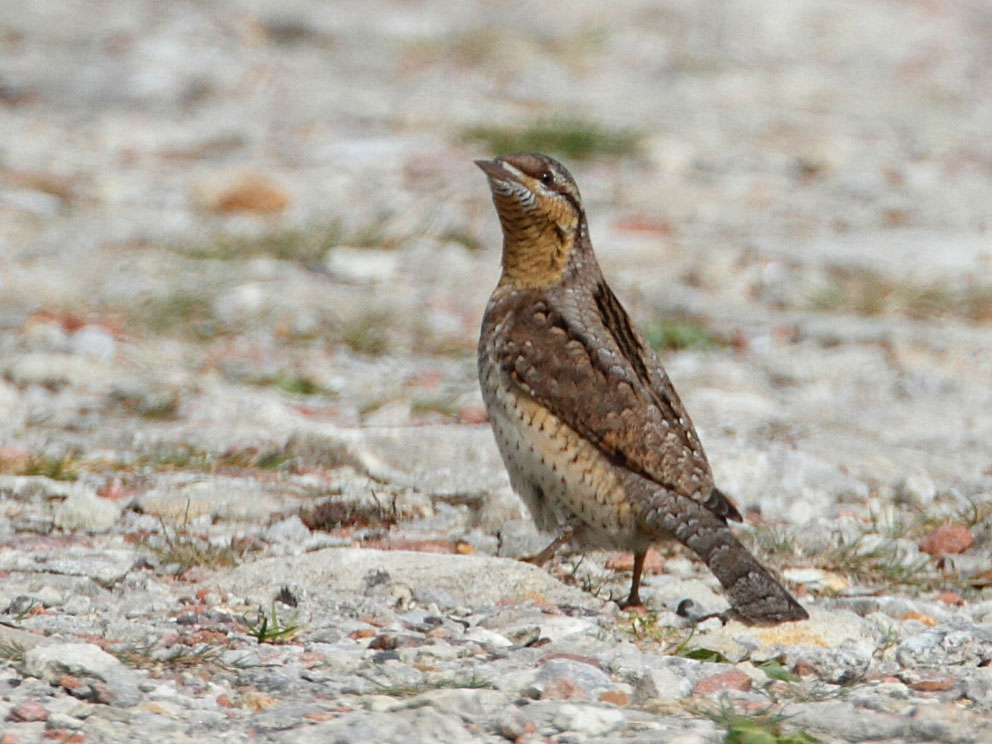
Wryneck becomes writheneck - a sad story

David Campbell and I decided to go to St Margarets at Cliffe today hoping to see large numbers of migrants amassing on the South cliffs before launching themselves off to faraway countries. It was very quiet. A wheatear, a chiff-chaff and some magpies were almost all we saw.


Wheatear


The pager showed a wryneck 'at Samphire Hoe Country Park'. Hardly the most precise directions. We were 20 mins away so decided to go. The park is 89 acres or something and we had no idea where to start. The chap in the office suggested the path at the back that runs alongside the railway at the base of the impressively high white chalk cliffs. We wandered down there, met another birdwatcher searching for it. He went off on another path.

We saw some stonechats and had almost reached the end of the path when we saw a bird fly from the bank to the top of a nearby bush. The wryneck! I got one shot as it flew away! I put out a message with a precise location. In the meantime a young stonechat with a bug stuck to its bill posed on the bush.


Stonechat

The wryneck came back about 10 minutes later but dropped down before I could get another shot. The man who had gone on another path was back now. It flew again and he saw it. It flew to a distant bush on the other side of the railway and we watched it for 6-8 mins. Then it flew and we lost it until David picked it up again on the path in front of us about 25 metres away! I took some photos before a group of walkers sent it over the fence.


Wryneck

About 6-7 other birders came to see it and they all did while it was feeding at the top of the bank.


Wryneck

We heard a train aproaching. The wryneck flew towards his distant bush on the other side of the track. All eyes followed it as it flew straight into the front corner of the approaching train. I and several others heard the impact and we all gasped. Was it killed by the train! We didn't know for certain that it had been killed but we were all pretty sure that it had. One woman burst into tears, bless her, at the shock horror. We were all affected at seeing such a lovely creature die.

I jumped over the fence to the path by the side of the track to see if I could find a body. I looked hard but there was quite a high wall between the path and the track. I couldn't see a lifeless wryneck but the train could have carried it for quite a way.

We waited another 15-20 mins but it didn't re-appear. We feared the worst and walked back to the car. We had to tell the newly arriving birders that the wryneck was no more.

We went to Bough Beech reservoir on the way home and the highlights were 3 green sandpipers, 2 snipe, bucketloads of pied wagtails and a grey heron fishing.


Snipe

It was a day that was initially joyful for having seen the wryneck but tinged with sadness at its likely fate! A memorable day shall we say. That's life!

Tuesday, 24 August 2010

Hobby at Banstead Woods.

David Campbell showed me the hobby he had found in Banstead Woods. The tree was empty at first but after about an hour the hobby came to sit at the top of its favourite perch. It stayed for quite a while until we left at dusk. We went back the following day at a different time so the sun was better and took some more pictures. A lovely bird to watch at relatively short range.


Monday, 9 August 2010

A week in the Scilly Isles and a pelagic 24-31 July 2010

After Cornwall, Lynne and I went to the Scilly Isles for a week. Last year I spent a weekend on St Mary's but I spent both days at sea so I didn't get to know the islands at all. Lynne had always wanted to come to the Scillies. We went over by ferry. I had expected to do a lot of seawatching on the trip but the weather was cool and windy. I did spend some time on deck where I met some members of the Notts Bird club who had kindly agreed to let me go with them on one of their pelagic trips.

Naturally, you have to go everywhere by boat on the Scillies. This is good business for the boatmen. A simple return to any island is £7.80. If you want to visit two Islands on the same day it's about £11.50.

On the Sunday we decided to go on a trip to the Eastern Islands before going on to St Martin's. We saw plenty of grey Atlantic seals on the trip to the Eastern Isles and this made Lynne very happy. Seals are okay but they're not nearly as exciting as birds! !

Now, I know there may be one or two of you who would like to see a picture of a small, cuddly baby seal, with that innocent looking face, the small snubby nose, the large appealing eyes, etc, but. . .


. . . Oh, all right then!


Atlantic grey seal pup. Aaahhh!


St Martins is one of the larger islands. The tides dictate where the boat drops you off and where it picks you up. We landed near one end of the island and were to be picked up near the other end. I liked St Martin's. The scenery was varied and the eastern end was fairly wild.

Shags are much more common than cormorant. Here's a shag feeding:

Come on, Mum. open up. I'm hungry:


OK. But don't get your bill too far in, it makes me gag!:


I said not too far down!!!:


Here are a couple of cormorants:


After a coffee at the local hotel we strode out to the other end of the island. We passed a field of linnets before arriving at Middletown at 1405. The local tea-room stopped selling lunch at 1400 and I got the blame for arriving late. We had another coffee and a nice piece of cake in lieu of lunch.

We walked to the far end of the island hoping to see some seabirds. We saw some gannets diving and also a basking shark. This also pleased Lynne, but she was now becoming uneasy about getting back in time to meet the boat. Lynne was not reassured by my reassurances. I had to cut short some photo opportunities for linnets, rock pipits, etc and we arrived back at the jetty half an hour before the boat was due to go.


Monday was quite misty. We decided to go to Tresco and looked round the formal gardens. These were quite nice but tranquility was shattered by the sound of a least two motor driven devices operated by workmen in the gardens. Sparrows were still feeding their young.


House sparrow.

Further on we also saw a golden pheasant, clearly now part of a feral population!!


Golden pheasant.


Someone had recommended the fish and chips at the local pub on Tresco. We decided to have it. It was pricey at over £11 each but the portion was generous and we had difficulty eating it all.

On Tuesday we decided to stay on St Mary's. We walked through the old town, on to the end of the airport runway and then to Porth Hellick, a local nature reserve. There was a nice common sandpiper, a sedge Warbler and a distant kingfisher on a post.


Common sandpiper.


Sedge warbler.

We walked on through another nature reserve to the heritage centre where I tried, not very successfully, to take pictures of swallows in flight. Just down the road was an interesting garden where some young blackbirds and thrushes came very near, not yet having learned to fear humans.


Song thrush waiting for his tail to grow.

On Wednesday we went to St Agnes. The Turk's head pub is about 200 m from the jetty, so the first thing we did was stop for coffee! Ambling on for a further half a mile we stopped near 'Big pool' which was supposed to be good for birds. It was actually quite small with only a few gulls on it. A little further around the island I came across 2 brown rats in a bush near the beach!


Brown rat.


There were also several willow warblers, presumably on migration:


Willow warbler.


From St Agnes at low tide it is possible to walk to the adjoining island of Gugh. There were hundreds of nesting pairs of lesser black backed gulls which didn't take kindly to our presence. We did see some rock pipits and some wheatears. The following sequence shows a bee approaching a wheatear, which ducks to get out of the way.


On Thursday we went to Bryher, one of the smaller islands. This probably had the fewest birds, but I did see a little egret on our approach to the jetty and, as we were leaving, a sandwich tern fishing, as the following pictures show.


That evening, Lynne came with me on a short boat trip to see the Manx shearwaters amassing on the sea before they go ashore to their young. We saw 2 or 3 rafts of birds totalling perhaps 200 individuals, as well as a basking shark.

Friday was the day of the pelagic trip with the Notts bird club. Our guide told us that conditions were better than they had been all week. However, it was a little early in the season. The pelagic was very enjoyable even though sightings were limited. We saw a number of storm petrels, a sooty shearwater, a few Manx, one or 2 great skuas and the usual mix of gannets, gulls and fulmars. A highlight was a grey phalarope, a British tick!


European storm petrel.


Sooty shearwater.


Great skua (bonxie).


Grey phalarope.


On the way back the gulls fought over the pieces of mackerell which the organisers threw overboard. I like this shot of a lesser black-backed gull getting the fish (lower right).


On Saturday morning we went to Porthloo on St Mary's, a very smelly beach. I don't know why. Lynne had a look round the small galleries and I scanned the beach for some reported Mediterranean gulls.

In the afternoon we left on the ferry. I spent some time on deck with the Notts Bird club and we saw a small number of petrels, several Manx shearwaters and a great skua. As we neared the Cornish coast 2 or 3 of us got onto a large shearwater with brown upper parts, darker brown wingtips and clear white underparts with dark fringes. I did not see the bill, but those who saw it agreed it was a Cory's shearwater, a lifer for me. My camera was in my rucksack unfortunately, but I'm sure it was a Cory's. The only other shearwater with upper parts like that is the great shearwater, but the bird we saw had no dark cap and no dark markings on the white underparts.

I don't want to give you the impression that this was purely a birdwatching holiday! We did a lot of walking, went to a singing concert of 5 local men singing sea songs, enjoyed innumerable coffee and cakes at various cafes, saw two glorious, but different, sunsets, and ate out at some of the local restaurants. Here are the 2 sunsets as well as Lynne and me just about to start our meal in 'the Boat Shed' restaurant, which was our favourite.


Me and Lynne at the 'Boatshed restaurant, St. Mary's.

Sunday, 1 August 2010

Cornwall - 19-24 July 2010

I was in Cornwall, Porthcurno, to sing in the chorus of 'The Bartered Bride', put on by Surrey Opera. The show was at the Minack open-air theatre in Porthcurno, the village near Lands End famous for being the point at which all the early telegraph / telephone cables entered the sea to go to America and, later, all over the world. The cables are now fibre-optic but they still go from Porthcurno. The telegraph museum is very interesting if you're down that way and the beach is very pretty.


Porthcurno beach.


The Minack theatre is fashioned with concrete out of the steep rocks of the south Cornish coast.  This shot was taken from the rocks at the point.


Minack theatre, Porthcurno, Cornwall.


We did 7 performances in 5 days but I did get a chance to do some birdwatching in the mornings some days!

Around the bay from Porthcurno is Logan's rock. I climbed round and spent most of my time watching a couple of rock pipits.


Rock pipit with grasshopper.


A trip to Cot Valley yielded views of the two male choughs I had seen earlier in the year as well as a distant buzzard.


Buzzard.


On Friday I went to Porthgwarra watchpoint where there is an official seawatch for Balearic shearwaters, the rarest of the shearwaters. An almost all-day vigil is kept counting the number of Balearic shearwaters passing near the Runnelstone buoy situated 1.5km offshore. Some other birds are counted as well, notably Manx shearwaters and auks (puffins, guillemots, razorbills, etc).  I met John Swann, the local co-ordinator, and Russell Wynn from Southampton University who explained the purpose of the watch and the importance of the Runnelstone reef. Russell had some very useful tips for long-range identification of seabirds. Thank you both. I did see quite a few Manx shearwaters and one Balearic while I was there. Also several guillemots and one or two razorbills.

On Saturday, Lynne joined me and watched the final performance before we headed for Penzance to take the ferry to Scilly the next day. Watch this space for the next post.