Monday, 10 September 2012

Long journey for short-billed dowitcher.

Flushed with my success with the Baillon's crake yesterday, I left at 05.00 this morning for Weymouth, Lodmoor, to see the short-billed dowitcher, an American wader. At 7.35 it was nowhere to be seen, despite there being about 8 or 10 birdwatchers on site. I decided to look on the South side which the long-billed dowitcher had preferred last year. I got about 200 metres down the path when a wader caught my eye. Through my binoculars it had all the hallmarks of the short-billed dowitcher. By that I mean it looked pretty much the same as the long-billed!! Sure enough, that was it. A couple of the others arrived but the bird moved into a clump of reed and stayed hidden for several minutes before emerging again. It was reasonably close but still tended to hide in the reeds a lot. I was back home at 12.00 noon.

A second lifer in 2 days. OMG, I hope I'm not becoming a twitcher again!!

Short-billed dowitcher - juvenile.

Sunday, 9 September 2012

Biding our time for the Baillon's crake

Was it worth the wait? Did we see it? Read on.

Got to Rainham RSPB at about 6pm where those nice people in the RSPB had decided to keep the reserve open on a Sunday till 8pm! Thank you all the staff.

Trudged round to the hide but the bird was nowhere to be seen. The hide was heaving. Then someone saw it briefly but not many could get onto it before it retreated into the reeds again. Standing on a swivel stool was risky but necessary to see over the heads of everyone and to get a better angle on where the bird had just been.

After over an hour one man left disgruntled saying he had been there since early morning but not had a glimpse because nobody could give any accurate instructions as to where they were seeing the crake!!

At nearly 19.25, the RSPB person announced that the hide would be closing at 7.30 so the reserve could close at 8. We started to pack up slowly. Suddenly, someone next to me announced that the crake was climbing up the reeds just in front of us. I quickly got onto it. It was already dark in the hide. I cranked up the ISO to 3200 and took a few shots before we had to leave.

Well, it was another lifer for me.
Baillon's crake - juvenile. It kept us waiting until the light was really poor.
This shot and the one following was taken at ISO 3200 and 1/25
Baillon's crake - juvenile.

Monday, 3 September 2012

It's a Race! A long one.

I haven't been out much since I got back from holiday so I was looking forward to the bird race at Canons Farm, Banstead Woods. I picked David up at 6.20 and before 6.30 we were there. Weather not brilliant; a bit drizzly at first. However, David picked up the call of 2 yellow wagtails flying over, the first of several birds he located by call that day.

6 or 7 birdwatchers attended. I went round with David most of the time, Ian went with Steve, Paul did his own round, and Roy held the fort at the highest point on the site and skywatched.

David and I walked around the field near the houses to get the garden birds. Suddenly we heard an unfamiliar call just over our heads and a large wader headed North away from us. I followed it briefly with my bins before trying a photo. I couldn't get a shot because the drizzle had got onto the lens of my viewfinder and I couldn't see the bird! Luckily, David got some shots and confirmed his thought that it was a bar-tailed godwit, a very rare bird in those parts and a first for the site!

We picked up the usual suspects during the morning. After lunch I headed for the Legal & General playing fields where I knew there would be pied wagtails. I wasn't expecting the number I found; 29 in all.

I then spent a while photographing the whinchat which was being quite co-operative on a nearby fencepost. The male common redstart nearby wasn't quite so obliging, but stealth and patience paid off. I then went to find the female about 500m away. I was lucky again with good views of the female common redstart.

Late in the afternoon I joined up with David again for a visit to the scrub. I picked up lesser black-backed gull and treecreeper on the way, followed by nuthatch, bullfinch, willow warbler, whitethroat and blackcap at the scrub, bringing my total for the day to 54. Notable absences of fairly common birds were goldfinch, song thrush and the red-legged partridge. These latter two were seen by others in the day.

After over 12 hours on site carrying my camera, my shoulders were aching a little!!
Whinchat
Male common redstart
Female common redstart

Sunday, 24 June 2012

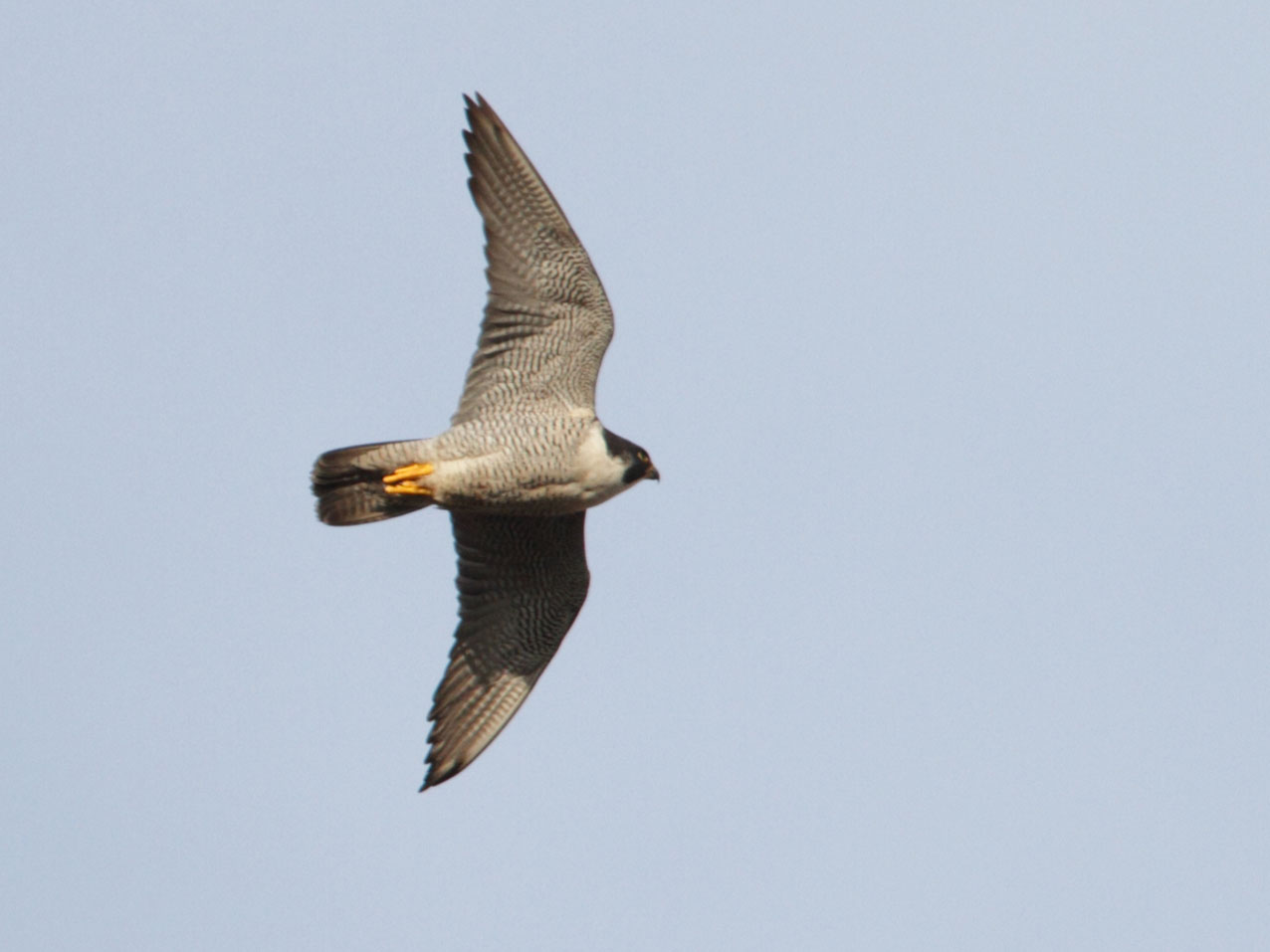
Sutton Peregrines 2012 - New pictures.

I went just after 6 a.m. on Saturday to keep watch over the young ones and take more photos. I saw both adults and 3 chicks, but I am pleased to report that all 5 chicks were seen on Friday evening. Great news! Mum was very active again, showing the young ones how it's done. Dad sat on his ledge for over 2 hours and did nothing! Neither parent brought in any food in the 3 hours I was there.

Two of the chicks flew while I watched. The third sat and peeked over the parapet. Here are some photos of the birds in flight.

The adult female
The chicks flying in formation!
A chick. Note the differences in plumage from the adults.
Flying Red Arrow style!
The chicks at aerial play above Quadrant House.

Friday, 22 June 2012

Sutton Peregrines 2012. Learning to fly.

The Sutton peregrines raised 4 chicks last year and 5 chicks this year. That must be almost a record!

Sadly, it's becoming doubtful whether all 5 have survived. Recently, only 3 chicks have been seen at the same time. On Thursday I went down for a couple of hours in the evening to keep watch. At least one of the young ones was flying regularly. The mum and dad flew to the nearby building and called to the chicks to join them. The mum was quite active in encouraging them. At one point she tempted them by hovering over them with the remains of what looked like a pigeon. In fact, it wasn't a very appetising morsel; just a scrap of flesh with a pair of wings attached! No wonder they weren't interested!

Mum was very demonstrative in teaching the one who was flying. She showed him the way and he struggled to keep up, flying with legs all over the place!

Here are a few photos.

Mum landing on the corner of Quadrant House
Wait for meeee!
Mum (or this could be dad) with ungainly chick following.
Mum takes chick into a dizzying dive!

Saturday, 16 June 2012

Black-winged stilt and little bittern

I've given up traditional twitching in favour of foreign trips but I have added 3 British ticks to my list in as many weeks. The first was the marsh warbler at Rainham. No photo I'm afraid as it only showed for a few seconds at a time while it flitted from bush to bush!

While at Chichester a couple of weeks ago I went to see the black-winged stilts at Pennington Marshes as it wasn't too far away. I hadn't been there before but I found it by chance on the first attempt. It was a drab and dreary morning but the stilts were on a pond only a couple of hundred metres from where I parked. There seemed to be an adult and a juvenile.  Here they are:
Black-winged stilt.
Blackk-winged stilt with a redshank.
Today, I decided to go for the little bittern which has been at Rickmansworth all week. I picked Alex up near his house and we headed round the M25 to the Aquadrome LNR. Unfortunately, we took the long way round, not knowing where the bird was. Eventually we got there and the little bittern was keeping a very low profile out of the wind! The sun went in and it started to rain. After about half an hour, the bittern came out of hiding and skulked behind some vegetation. Then it came right into the open for about 30 seconds enabling me take a few photos and a short video before it disappeared back into the undergrowth.

Little bittern, Rickmansworth.

Friday, 8 June 2012

Istanbul weekend May 2012

We spent a long weekend in Istanbul over 3-7 May. I decided to travel light and took only my Canon compact zoom camera (SX30). A big mistake! The city was live and bustling. Mosques all over the place. Hotel was good, food too. We visited the Blue Mosque, the Bazaar, the Spice market, the undergroud cistern, Topkapi Palace, went on a round city bus tour, had a meal in a restaurant where the floor show included whirling dirvishes and a belly dancer, did a cruise on the Bosphorus, had coffee in various cafes and generally chilled out.

The birds were not terribly evident in the city. There were grey herons nesting in the trees of the local park, all the doves were laughing, all the gulls were yellow-legged, all the crows were hooded and all the parakeets were Alexandrian. The trip on the Bosphorus was interesting for the large flocks of Yelkuan shearwater that made their way up towards the Black Sea. The photos were mainly taken with my daughter, Louise's, Canon 1000D with a small 15x zoom lens as my Canon SX30 turned out to be almost useless for any sort of action shot as the screen blanks out for about a second after every shot before coming back on. Following any sort of action was impossible. Should have taken my 7D!

Lynne, me and Louise on the terrace of the Topkapi Palace.
Louise outside the Blue Mosque
Yelkuan shearwaters heading up the Bosphorus
Alexandrian parakeet
Laughing dove

Saturday, 19 May 2012

Bona fide bonaparte's gull at Creekmouth

I'm still wading through a mountain of photos from my Costa Rica trip but, in the meantime, I went today with David Campbell to his patch at Canons Farm and saw the handsome red-legged partridge that was still there.
Red-legged partridge
News came through of a bonaparte's gull at Crossness! A lifer for me and a London tick for David. We set off and it moved to the North bank while we on the way. A friend of David's saw it just before we arrived but we failed to locate it after a couple of hours. We started back and had got over the Dartford crossing and 6 or 7 miles south when news came through that it had returned.

We went back and saw a group of birdwatchers way along the bank at Creekmouth. I decided to run as I thought the bird was drifting down river away from us. I puffed up to see the bird through someone's scope and had about 10 seconds before it flew off!! David didn't run and missed it. However, after 25 or 30 mins it showed up again and we got good though distant views. The tide was right out so the birds were quite a long way from the bank. Light also not good as very overcast. The poor thing was constantly chased by black-headed gulls so it was on the wing most of the time. Here are a couple of photos showing the main ID features: black spot behind the eye, relatively clean underwing, black bill and pink legs.

Bonaparte's gull (in the middle)

Bonaparte's gull chased by black-headed gull

Went back on Sunday to try and get a better shot. I did get a little closer. Here three of the main ID features are shown better: spot behind the eye, black bill and pink legs.


Bonaparte's gull - with larger juvenile herring gull.

Tuesday, 3 April 2012

Cute little owls and more Short-eared owl photos

After some tantalising views of 2 little owls at Cobham I had to return when the light was better. I braved the rush hour traffic and arrived at about 0800. The sun was shining and the light was perfect. Would the owls be there? Well, yes, they were. Shortly after I arrived they both appeared in their hole in the branch and looked out at me. Cute!!
Little owls. How sweet!
I also went in search of better shots of the short-eared owls at Papercourt Marshes. Again, the light was very good, there was no wind. Conditions for photography were perfect. We had some quite close views, but no picture is perfect and focussing had to be done manually because the owls always fly quite low making it impossible to distinguish them from the background of trees and bushes.
Short-eared owl.
Short-eared owl.

Friday, 30 March 2012

Short-eared owl at Papercourt Meadows

In the morning I went to Banstead woods to join David for a bit of 'patching'. David's friend, Richard, was also there. As we were moving off I noticed a male reed bunting on top of the hedge. David was sceptical but Richard managed to get his scope on it straight away. After a few seconds it dropped down the other side of the hedge and was never seen again!! Poor David didn't see it and it is quite a rare bird for that area!

Chiff chaff - Banstead.
Blue tit - Banstead.
Dunnock - Banstead.

Later that day, I went to Papercourt Meadows. I'd wanted to check out the short-eared owls, there for some time. Even with the petrol shortage I felt it was worth the 17-mile drive.

Found the meadows OK but wasn't sure where the owls would be. Decided to walk away from the sun so the light would be better. Got distracted by some stonechats for about 45 mins. Then I saw a chap on a fallen tree trunk watching something. As I approached him he said there was an owl. A few seconds later a beautiful Short-eared owl flew from its perch in a tree about 150-200 metres away and started quartering the field. He quickly flew off and didn't come back for 20 mins or so. Managed some distant shots but he never really came very close. I may go back again soon to get closer.
Stonechat, male - Papercourt Meadows
Short-eared owl - Papercourt Meadows