Thursday, 13 May 2010

A chiffchaff like any other (almost)

When is an ordinary chiffchaff not an ordinary chiffchaff? Well, when it's an Iberian chiffchaff, of course. Blowed if I could see much difference but there it was and I took it's picture. It's hard to get too excited about a chiffchaff but it is a new lifer and a year tick too. It was rather wet when I went so I borrowed Lynne's umbrella with the flashing LEDs to cheer up the birds. The poor chiffchaff looks quite bedraggled. It's a good job it was so obliging and came out to sing instead of hiding from the rain.


Iberian chiffchaff, Kent


After that, I went on to Dungeness RSPB and was lucky to see the purple heron briefly as it flew.

Tuesday, 13 April 2010

Pulborough in bloom. Spring is (almost) here!

On Monday I left early to visit a local place near Oxted hoping to see a ring ouzel. It was a nice walk but no ring ouzel. This is my bogey bird at the moment.

I then went to Pulborough hoping to see the common crane which had been there for a couple of days. On arrival I raced down to Jupps viewpoint but there was no crane. Twitching is no fun when you miss all the birds!! Shortly after, a man came from the other viewpoint and said the crane had flown at 10.05 and I had arrived at 10.10! Grrrrr!

To compensate, there were two snow geese, a life tick for me after my signal failure to see this bird in Norfolk. When I came back later they were closer to me and promptly mated!! Well, it is Spring.


Snow geese.


Although cold, there were sunny intervals and some of the bushes on the reserve were in bloom. This allowed me to spend some time relaxing with the great tits, which were nibbling the buds out of the blossom. They look very nice with a floral background.


Great tit.


I also found a number of blackcaps. I got a nice view of a male, but the females were keeping a low profile, probably building nests and being homely.


Blackcap, male.


This bold chiffchaff was collecting nesting material.....


Chiffchaff.
(shorter wings,
darker legs)


....and this willow warbler was very actively staking out his territory in song. Magic!


Willow warbler.
(Longer wings,
paler legs)


If these two birds look almost identical it's because they are, almost identical. Telling them apart by song is easy. However, other features are the length of the wings and the leg colour. The wings of the chiffchaff are generally shorter. You can see from the pictures above that the wings of the willow warbler extend further back than the chiffchaff. Also, the legs of the chiffchaff are darker than those of a willow warbler.
The crane didn't reappear that afternoon, but I didn't mind after the lovely birds I'd seen.

Close encounter with grasshopper warbler.

On Friday, 9 April, I went with David to Rainham. We went first to Ingrebourne Valley where a grasshopper warbler had been seen the previous day. The instructions were not precise and we had to walk all over the reserve to find the spot.

David found the bird which performed admirably for us, coming close and reeling from the middle of a nearby bush. It was very mobile however and neither of us managed to get a shot. This was a good start to a day which, on the whole, was rather disappointing. Nothing further of note was seen despite trips to Minster (didn't see ring ouzel) and Elmley marshes. At Elmley, however, the drive from the road to the car park was pleasant with views of about 100 curlews, a brown hare, several lapwings, redshank and other common birds. The Spring influx seems to be late this year.


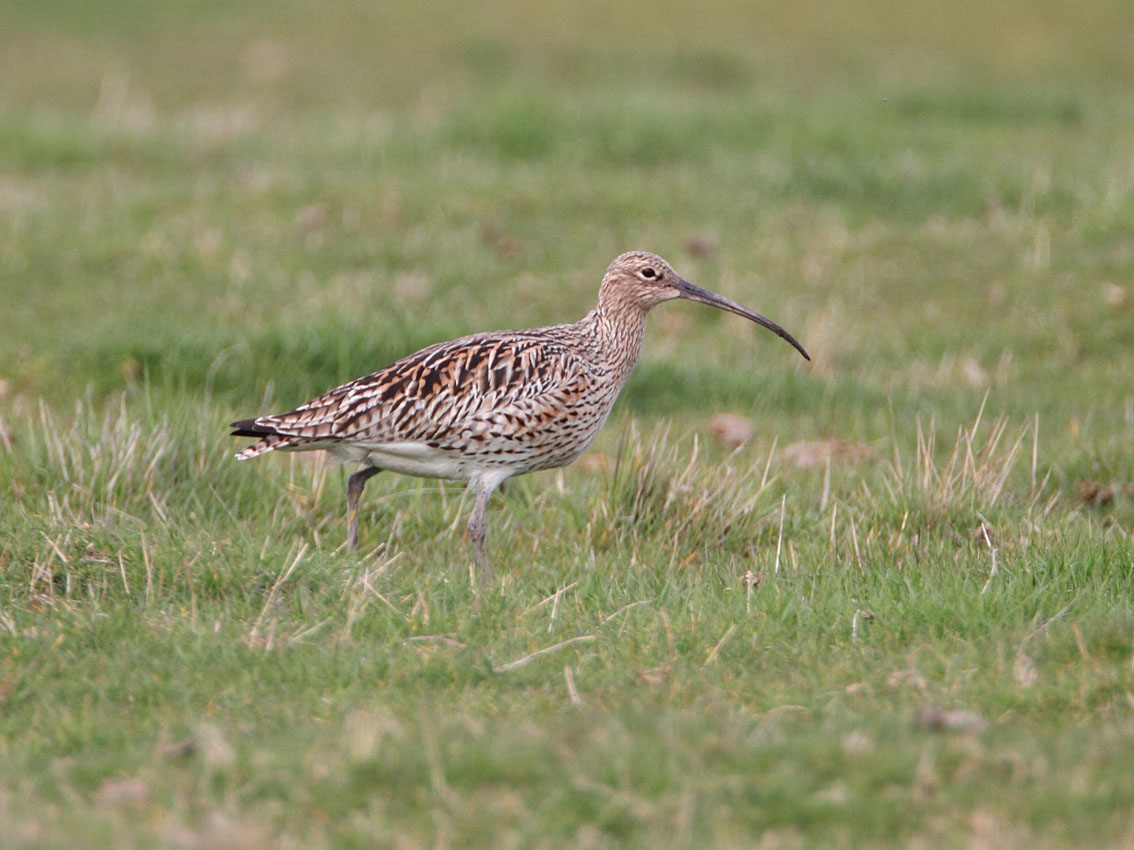
Curlew.


Brown hare.
(David took this photo)

Tuesday, 6 April 2010

Hoopoe at Rainham. Alpine swift at Chafford Hundred.

This weekend wasn't one of the best weatherwise, admit it. I'd done nothing all weekend and on Easter Sunday my nine year-old niece was to be baptised at Rainham church. I duly put on my best bib and tucker. The service was nice and the lunch was relaxing. Afterwards, I took Lynne to see her other sister and I sloped off to Chafford Hundred, just on the other side of Lakeside to see if I could find the Alpine Swift that was reported late yesterday. I'd not been there before but I got to the right place at about 3.45 pm. and there was one other birdwatcher there. The swift, of course had just been there, but it had just disappeared! The chap told me that the others had just gone to Rainham because a hoopoe had been reported and Ranham closed at 5pm. We agreed it would be best to go to Rainham before it closed.

At 4.10 I arrived at Rainham. Through the telescope the staff showed me where the group watching the hoopoe was. It was about as far from the centre as you can imagine. For those of you who don't know Rainham that is about 3km or 1.5 miles. I didn't think I could get there and back by 5pm. She said "You can if you're quick!"

I raced off with a few others and we arrived, hot and bothered on the other side of the reserve. The group started moving off at that point. The hoopoe had just flown. Ohh, nooo!! It was quickly re-located on a wooden fence behind a metal fence. I soon got it in my scope and fired off a few shots.


Shy hoopoe.


It was a British tick for me. It was quite distant and I decided to go back for the swift straight away. I got back to the RSPB centre just before five.

No sooner had I arrived back at Chafford Hundred than the alpine swift reappeared. It was showing well but it took some time to get the focus right on my camera. Autofocus is useless with a small bird flying high and at speed. I prefocussed roughly and then followed it while I tweaked the focus ring before firing off a few frames. Some of them came out. Another British tick and a life tick too! There were also some sand martins and swallows about.


Alpine swift


I thought I'd better get back to Lynne, but I was pleased at two British ticks in a couple of hours.

David Campbell had rung to tell me of a ferruginous duck at Holmthorpe but I coudn't get back in time for it. I went this morning (Monday) but it wasn't there. I missed another British tick there.

A Ring-necked duck on a circular tour! Monday 29 March 2010

On Monday 29 March I planned a circular tour hoping to get up to my last year's total for the end of March, 145. I was on 144.

I started off at Aston Rowant NNR just off the M40 near Watlington, where a ring ouzel had been seen. I didn't see this potential lifer but I did see a nice female yellowhammer and of course some red kites. Watlington is the place for them. The red kite was year tick.


Female yellowhammer.


I moved on to Foxcote Reservoir for the ring-necked duck. Access was a little difficult via a public footpath which could only be accessed through a farmyard and the farmer wasn't too happy. He told me I should go to the hide 700m away. I asked if I could see the water from the public path and he told me I could but there were no rare birds there. I said I would just have a quick look. I quickly got onto the ring-necked duck on the far side of what was a fairly small reservoir. I got a very distant record shot and decided to move on as I had far to go.


Ring-necked duck.
Distant record shot.


Next stop was the RSPB headquarters at Sandy in Bedfordshire where a two bar crossbill had been around for a couple of days. I got there and it had been seen with a flock of about 40-50 common crossbills. I'd never seen so many crossbills but they proved elusive and, although a flock of about 20 flew in we couldn't see the two-bar. After about an hour I decided to move on but I then met a man who said the two-bar was showing well on the other side. The reserve isn't that big so I raced around but the bird had just flown. Then the flock came into a distant but bare tree and after a little scanning, I made out the two-bar crossbill. A nice year tick.


It was getting late. Although it was a two hour drive, I decided to go for the lesser kestrel at Minsmere RSPB, where Nick, local birder, had already been this morning and seen it. About half an hour into the jouney, it started to rain and it didn't stop. It was raining when I arrived and the lesser kestrel hadn't been since it had started to rain at about 3pm. I stayed only 10 minutes. After checking the forecast was rain for the rest of the day, I decided to call it a day and go home. With the red kite, ring-necked duck and two-bar crossbill I ended March on 147.

Monday, 5 April 2010

Springtime at Painshill

Last week I went with Tricia to Painshill Park hoping to see a kingfisher. Spring was in the air with most birds dancing and making eyes at their partners or prospective partners. We didn't see a kingfisher where Tricia had seen them before but we did see two mute swans mating. The poor female was pushed right under until the male chivalrously pulled her head above water with his bill!!


Hold still dear, this won't take a minute!!


We also saw two nuthatches inspecting a very tasty and promising hole in a tree with a 'to let' sign outside. It looked as though they were going to take it.


Nuthatch.  Let's see how much room there is in here.


The terrapin was out enjoying the odd sunny interval as we were.


I love the sunlight. Terrapin.


After most of a circuit we repaired to the tea room for lunch and to warm up. The rain had mainly kept off during the morning. after lunch we went back to the river where a tree creeper flashed silently to a nearby tree on the far bank. Then Tricia saw the tuquoise flash of a kinfisher and we watched it disappear round the bend of the river. Well, at least we saw it. Thanks, Tricia for showing me round.

Sunday, 14 March 2010

Hawfinch at last in New Forest.

As David Campbell hadn't been able to see the bufflehead in Dorset, which seems to have taken up residence, I went a second time hoping to get some better shots of it. It was nice to see it again but it was still fairly distant for photography but fine for telescopes.

We then went in search of the great grey shrike which had been reported near Burley in the New Forest. We stayed for about an hour but there was no sign of it 'behind' the car park as reported. A brief visit to Acres Down was a mistake as the sun was gone and so had the raptors, apart from a couple of buzzards.

We therefore headed for Blackwater Arboretum hoping to see some hawfinches, which I had seen all too briefly the other day. This time we were in luck with several small groups flying in and sticking around for a couple of minutes, albeit at the very top of the tallest trees. I managed to take several shots in attractive light.


Hawfinches. Female top, male below.


Hawfinch. Female.

As we were leaving a further report of the shrike came in. As it was only ten minutes away we decided to go back again, but a further scan of all the likely bushes failed to reveal the bird. Despite this, we left happy to have seen the bufflehead, and I was very happy with the hawfinches.

Friday, 12 March 2010

Bufflehead in Dorset - 8 March 2010

As I had a day off on Monday I went to see the rare American duck that had appeared in Dorset near Langton Herring. That part of the Dorset coast is separated from the sea by the longest shingle bank in Europe, Chesil Beach, which stretches for nearly seventeen miles from Portland to West Bay. The lagoon formed by the shingle bank, the Fleet, is partially tidal and the water is brackish.

Wanting to avoid the rush hour traffic, I left home at 05.30 and arrived at the Fleet at about 0800. I scanned the water but no sign of the bufflehead, as the duck is called. My view of the Fleet wasn't clear as the coast has irregularities that obscure the view. Then the pager bleeped and I read 'no news of the bufflehead'!! Great!

Shortly afterwards the pager bleeped again and confirmed that the bufflehead was present. Judging by the position given I should have been able to see it, but I couldn't.

A few more birdwatchers arrived and we rounded a hill to get a better view of the Fleet. The bufflehead was way off in the distance but easily identifiable by its unique markings. We decided to get closer by going to Langton Herring. Even from there it was fairly distant and this shot is just for the record.


Bufflehead


After gleaning some useful information from Jackie as to where I might find hawfinches (thanks, Jackie), I went to Radipole Lake RSPB in Weymouth to see the long-staying hooded merganser, then to Portland Bill for a little seawatching.


Hooded merganser


On the way to Portland I stopped at the top of the hill to admire and photograph the magnificent view of Chesil Beach, the Portland isthmus and Weymouth.


Chesil Beach. At over 16 miles, the longest shingle bank in Europe.


At the Portland Bird Observatory, near the beach I noticed a small flock of rock pipits, which allowed me to get fairly close. There were no black redstarts, however.


Rock pipit.


At Portland Bill I saw some common scoter on the sea, and a couple of gannets.

There was time to go to the New Forest before dark to see if the hawfinches were about. I had some trouble finding the arboretum but when I did get there those waiting said they had seen nothing. A goldcrest entertained us from a nearby conifer.


Goldcrest

All the other birds that flew in were greenfinches, chaffinches, goldfinches or siskins. One or two of the birders left to go home as the light faded. Two other birds flew in and I looked through my scope to see a nice pair of hawfinches at last!  In the time it took me to take off my scope and pick up my camera they had gone. Ah, well! At least I'd seen them.

Tuesday, 9 March 2010

A couple of days in Norfolk! 2-3 March

With the high tides of the full moon at the start of the month I decided to go to Norfolk for a couple of days. I drove up on Tuesday night after work, getting in at about 21.40 to Dove Cottage B & B at Dersingham where I stayed last year. High tide was at 08.08 so it wasn't too early. I needed to be there an hour before high tide, so I got up at about 06.00! A quick breakfast left for me by Doug and Mo and I set off for the RSPB carpark at Snettisham. It's about 25-30 mins walk to the beach from the car park and I got there at about 07.20. Even so, it appeared that most of the knot had already flown over into the roost as there were almost no large flocks flying over my head. Watching the knot and oystercatchers from the roost hide was nice but not a patch on last year when the birds were constantly up and swarming around because someone had crawled to the bushes just behind them and kept flushing them with the result that I was able to film the huge flocks of knot in the air.

There were about 100 avocet which flew off at one point only to return a few minutes later, perhaps because the water hadn't receded enough for them. A single Mediterranean gull flew in to join a headless one-legged greylag goose on the island!


Mediterranean gull.


Whilst in the roost hide I also saw the world's first four-winged shelduck. Amazing!!


Four-winged shelduck?


After the roost I headed back to the beach chalets where two shorelarks had been reported. I found a couple of birdwatchers looking for them. Soon they were discovered and I managed some pictures before they flew off. They are so well camouflaged in the stones of the beach that they are very difficult to see.


Shorelark


I headed off to Titchwell for a spot of lunch and hoped to see a brambling as they usually have one each year. This year there was none! I did, however, get good views of a water rail in the ditch near the visitors' centre. I met someone who had spent a few hours on the beach seawatching who told me he'd seen very little on the sea so I didn't bother to walk all the way to the beach in the biting wind.


Water rail.


I walked back to the car and on the way scanned the undergrowth with my binoculars to see if there were any woodcock. After a few minutes I was amazed and excited to see some rusty coloured feathers. Closer inspection revealed that it was indeed a woodcock deep in the undergrowth. I positoned my camera to get the best shot possible but the vegetation around it is clearly visible.


Woodcock

I was also approached by a cute wren looking for insects in the bark of a local tree.


Wren


I knew there was a snow goose at Holm next the sea and I went to look for it. I met a guy from Norfolk who gave me afew tips for where to see birds and he told me the goose was best seen from Thornham. It didn't take long before I was looking at a domestic goose only through my telescope, but not before I had flushed a couple of grey partridges which flew a short distance away. I was able to take photos as close as I had ever been to these shyest of partridges. Also of note was a merlin hunting low over the marsh.


Grey partridge


Domestic goose - Bahh!

It was getting dark now so I headed for Dove Cottage. 

The following morning, Thursday, I was up fairly early and set off for Titchwell again. I had decided not to stay a third night in Norfolk as I had to go to Bristol for Friday afternoon. The truth is I was caught doing 36 mph in a 30 mph area and I had to attend a speed awareness course on Friday afternoon! It would take four and a half hours to get there from Norfolk so I decided to go to Slimbridge near Bristol on Thursday night and spend Friday morning at the Wetlands Centre.

At Titchwell I got even better views of the water rail than yesterday and also saw the flock of twite which had been reported. The pager that Lynne got me for Christmas was coming into its own! Also that morning I saw three spotted redshank on the marsh.

After lunch I started down to Lynford Arboretum where the local birder had told me there was a good chance of seeing hawfinch. I found the spot with some difficulty but then met up with two others from Kent who had also come looking for hawfinch. We watched for an hour and a half and were rewarded with some crossbills, also a nice find.


Crossbill, female

After an hour and a half the sun had shifted to the other side so I decided to go the other side of the trees. In the time I was away, two hawfinches came but I didn't see them!! Aaagghh! After a quick stop at a certain location to see if the stone curlews had arrived yet (they hadn't) I set off for Slimbridge to stay the night at a B & B only 800m from the gates of the WWT itself.

There were a lot of works going on in reshaping some of the scrapes. I headed for the Zeiss Hide in the furthest corner and after some hard scanning of several hundred teal I finally made out the green-winged teal (the American version of our teal) by its white, vertical flank stripe. Our European teal has a horizontal white stripe.


Can you spot the green-winged teal? This photo is cropped to make it easier.


I had a light lunch at the canteen before heading off for my course. This was very informative and interesting and it really did make me aware of the dangers of speeding. I'm reformed and I have been driving much more carefully since.

Tuesday, 23 February 2010

Dusky warbler at Walthamstow - 20 Feb 2010

I'd seen the dusky warbler at Walthamstow once already, in the rain and poor light of dusk (sorry) but I decided to go back on Saturday 20 Feb when the sun was shining. Almost immediately I was able to get relatively close views from across the canal. Fired off lots of photos of the bird which was very mobile indeed and seemed to be flycatching. Happy that I'd got some good shots in the bag I went in search of the white-fronted geese at Ingrebourne Valley, late afternoon.

Only then did I realise that I'd taken all the dusky photos at 3200 ISO!! Aaaaggghhh!! That'll teach me to check the settings before using the camera. Anyway, here are a couple of what I suppose will have to be record shots now!!