Showing posts with label Nepal. Show all posts

Thursday, 4 July 2013

Travels in Nepal 2013 Part 3 - Chitwan Nature Reserve.

Next day it was time to take a sad leave of Koshi. A long drive to Chitwan nature reserve far to the West awaited us. The journey was uneventful except for the sight of some Himalayan griffon vultures eating a dead cow not far from the edge of the road. You can get some idea of the size of the vulture compared to the large-billed crow beside it. The crow is quite a large bird.

Himalayan griffon (vulture) with a large-billed crow.
We arrived at Machan Paradise View Lodge in the evening for a 3-night stay.

Machan Paradise View Lodge, looking towards the bar!
Machan Paradise View Lodge, our room is bottom left.
Before dinner we learned from a talk that the reserve was very extensive. There were about 140 wild tigers, over 400 wild rhinoceros and many other smaller mammals. Large areas of the park were covered with tall grasses but 90% of it is forest, made up largely of 'sal' trees. We were dismayed to hear that our chances of seeing a tiger were slim!

The Hindu festival of Holi was just starting as we arrived at Chitwan. Here are a couple of revellers.

Two Holi revellers who really took the festival to heart.
We were also treated to local dancers. Lynne joined in the entertainment!

Local 'dancers'.

Lynne getting into the swing of things!

After a good night's sleep we were up before dawn for breakfast. As someone who doesn't like bananas I have breathtaking news!! I ate a banana pretty well every day in Nepal. After eating 2 bananas in Gambia 2 years ago, I started eating bananas for breakfast sliced on my porridge (yes, porridge is big in Nepal). To prove it, here is me eating, and obviously enjoying, a banana!


Unbelievable but true!
I had bananas every day on my porridge.
After breakfast we were straight inside the park acting as bait for tigers! Well, that's what it felt like at times, but we lived to tell the tale. Only once or twice did the spotter ask us to move rapidly away from some movement he wasn't happy with! He had a stout stick with him which I thought might not be much good against a tiger. On talking to him, however, I learned that the stick was not to beat the tiger but to beat the ground in order to make a noise that frightens tigers. I hoped he was right!

Oriental magpie-starling

There are quite a number of 'babblers' in Nepal. Here are some of the ones we saw:


Chestnut-capped babbler
Striated babbler ('streaky' in other words).
Yellow-eyed babbler
Everyone likes a bee-eater. Here are two that we saw at Chitwan:

Chestnut-headed bee-eater
Green bee-eater
 Most of the grassland birds were small and distant I'm afraid:

Ashy prinia
Grey shrike


Rufous-rumped grassbird.
This one was great. Sorry you can't see the red rump in this picture.
Although not a grass bird, this Chestnut-bellied nuthatch was the one that looked most like our nuthatch.

Chestnut-bellied nuthatch
Sikeer Kalkoha
Mid-day was generally hot and the others slept while yours truly wandered around in search of other avian rarities. One of the ground staff pointed out this bat roost in one of the bushes just a few metres from our room.

Short-nosed bats roosting just behind our room

The camp and Chitwan were home to several species of parakeet. I know they look like ours, but they are much more colourful.

Plum-headed parakeet - male
Plum-headed parakeet - female

Rose-breasted parakeet
In addition, there were 3 types of myna bird. Here are 2 of them:

Hill myna
Jungle mina
While at Chitwan we enjoyed an elephant ride one afternoon. The elephants generally work with one keeper/driver. In India they are called 'mahouts' but in Nepal the drivers are called 'phanits'. A phanit would be very offended if you called him a 'mahout' who, in Nepal, is really just one who cleans out the elephants' stables.

Ram, our 'phanit' (the name for one who drives the elephant)
Most (perhaps all) safari elephants are female. Females are calmer. Ours was 45 years old.

We were impressed at the strength of the elephants. They could carry four people plus the phanit with ease and trundled through the marshes and up steep banks at a slow steady pace. Getting the beast to move required a lot of effort by the phanit, who was called Ram in our case. Ram was constantly moving his whole body back and forth on the elephant's neck to urge it on. This caused Ram to sweat profusely in the late afternoon heat. Ram carried a fearsome hammer cum hook cum blade which was really quite heavy. As we strode along, the elephant constantly grabbed bunches of grass with her trunk and ate it. She had to be encouraged to move on. Ram only used the hook twice but it was a heavy blow with the flat part which made the elephant roar. I hope it was not that painful bearing in mind the elephant's enormous bulk.

To get on and off the elephant we climbed up a specially constructed wooden tower. The elephant backed into it. We them scrambled onto it's back one by one.

When we tipped Ram at the end, he had taught his elephant to take the notes with her trunk and deliver them to her master. You can just see them in this picture.

Ram's elephant with our tip in its trunk

We saw several rhinoceroses and crocodiles in the park. Here's a rhino:
 

Greater one-horn rhino
The crocodiles are called 'marsh muggers' and grow to several metres long. I wouldn't like to meet one if I wasn't on top of an elephant!

A marsh mugger
Although not a problem for us, insects abound in this part of the world. The hotel had a huge hornets' nest on the side of the main building and the bridge over the river sported four of them:

Hornets' nests on the local bridge

We took a jeep safari for a whole day, mainly in search of birds, but it was on this trip that Will suddenly shouted 'tiger' as he saw one cross the track a couple of hundred metres ahead. By the time we had reached the point where it had crossed, we were just able to see it disappear into the forest. No photo but it's true, honest!

We saw many skulking forest birds as well, including a bird which you may recognise! It's the original ancestor of our own domestic chicken, the red jungle fowl. It's completely wild in Chitwan.


Recognise it??
The Red jungle fowl is completely wild and hard to see in the forest.
We also saw the charismatic and beautiful Indian roller.


Indian roller. A wonderful, iconic bird.

Indian rollers have lovely wing patterns in flight:


Indian roller

On the way back from our day trip to the forest we witnessed another eerie event. From the forest track we saw a large sambar deer. It wasn't far from us and was looking intently away from us, staring at something, completely motionless. Normally a deer would look at you and flee, but not this one. We scanned the area beyond the deer and I thought I saw the black tips of the ears of a tiger amongst the grasses! So did Suchit! The deer stood motionless and it's only acknowledgement of our presence was the turn of a single ear in our direction. After what seemed like an age the deer suddenly flew like the wind away to one side while letting out a deafening bellow. It had escaped and the tiger melted away.

We took several walks in the forest at Chitwan. On one walk we met this cheery group of women on their way to work. Women don't like having their picture taken but they agreed to be photographed with Barbara.


Barbara (2nd from left) and Nepalese women

Woodpeckers abounded in this forest. There were three similar species of flameback woodpecker. In order they are: black rumped flameback (more common), Himalyan flameback (rarer) and greater flameback (rarest). Eventually we saw all three (we saw the first one at Koshi). The difference lies in how thick and dark the eye-stripe is. The rarest has the thickest, darkest eye-stripe. I'll let you work out which is which. (but I've made it easy for you). The second picture shows particularly well why they're called 'flameback'!


Doesn't he look like a pirate with mask and red cap?
By the way, many animals or things are 'Himalayan' in Nepal. e.g. 'Himalayan bulbul' or 'Himalayan flameback'. Suchit, our guide, was very insistent that it should be pronounced Hi-mah-lee-an, with the stress on the 'mah' rather than Hi-mah-lay-an, as most Europeans say, with the stress on the 'lay'.

Another river trip rounded off our stay in Chitwan. Near the river, this woolly-necked stork waded in the shallows.

Woolly-necked stork
This river trip made me realise how many races (or variations) of pied wagtail there are.

 
Pied wagtail

Me

Citrine wagtail
All good stopovers come to an end, and soon it was time to drive to Nepal's second city, Pokhara.

PHOTO SIZES - What do you prefer?

In this blog post I'm experimenting with larger photos. I've put in several sizes of this shikra (like our sparrowhawk) giving a lizard a lift!  The normal default size is this:

Normal size photo
This photo is 'large'

This is 'extra large'
This photo is 'Original size'


To be continued . . . . 


Saturday, 29 June 2013

Birdwatching in Nepal 2013 - Part 2 - Koshi

Flight to Koshi.

The following day, Monday 18 March, we took a morning flight to Koshi. Suchit made sure we got seats on the right side of the plane to be able to see the mountains. He pointed out Annapurna, Everest and several others during the short flight. As we neared Koshi we could see from the air the huge scale of the Koshi River.

We were quickly on our way to Koshi camp in an open topped Jeep. Koshi camp is a great place, next to some old fish-farming lakes. We were to spend four nights here in tented accommodation. The tents were basic but of good quality and semi-permanently pitched under a very permanent roof. There was electricity only when the generator was running but this was not a problem. There was no electricity in the tents of course. We had been warned of the limited facilities but the fantastic birdlife made up for any minor inconveniences.

Koshi camp showing the tents under the solid canopies.
While the others had a lie-down after the journey I wandered around the reserve on my own. I came across bronze-winged jacana, moorhen, oriental magpie-robin, jungle babbler, rufous treepie, purple heron, olive-backed pipits, etc. on my travels.

Jungle babbler
Indian golden oriole
Bronze-winged jacana
Bronze-winged jacanas getting to know each other!
Oriental magpie-robin - male
Oriental magpie-robin - female
Olive-backed pipit
Rufous treepie

In the afternoon, we explored the raised track to the West and this turned up many new species including Common Tailorbird, Blue-Throated Barbet, Black-Rumped Flameback, Stork-Billed Kingfisher, White-Throated Kingfisher, Blue-Tailed Bee-Eater, Asian Koel, Red-Wattled Lapwing, Black-Shouldered Kite, Red-Naped Ibis, Asian Openbill, Lesser Adjutant, and Rose-Ringed Parakeet!! Yes, we get those parakeets in England too, but I like them!


Blue-throated barbet roosting in a nearby bamboo

Asian openbill (left) and Black-headed ibis

Stork-billed kingfisher

Asian Koel (pronounced 'coil'). The male
In the quiet of the camp, the Koel had a very loud rising call. Here is the best one I found on YouTube. The note at the start of this video is typical of the region. You only need to listen to the first half minute or so.  http://www.youtube.com/watch?v=6_HW81szhm8  The female Koel looks (and sounds) quite different.


Asian Koel (pronounced 'coil'). Female

White-browed wagtail
The following day we were up early to go on our first Koshi river trip. We soon arrived at the enormous flood plain, picking up sand lark before the gorgeous oriental courser. Coursers certainly can run but we got to within a couple of hundred metres and saw them mating!

Sandlark

Oriental coursers
While having breakfast on the banks of the river we enjoyed flocks of ruddy shelduck, bar-headed geese, great crested grebes, small pratincoles and little terns flying over.

Getting ready to cross the Koshi river to a semi-permanent island.
Notice how vast it is, and it's not even monsoon season!

Bar-headed geese over the Koshi river

Great-crested grebes. Remember them?

The island we crossed to was semi-permanent. Depending on the monsoon and the height of the river, islands were formed or removed every number of years. If one happened to remain for a few years, grass and small bushes would grow attracting wildlife.

During our walk on the island we encountered common kestrel, Montagu’s harrier, wryneck, red-wattled lapwing, oriental stone curlew, different prinias, and the critically endangered Bengal Florican, a bird about the size of a goose.


The quite rare Bengal florican - distant.

Little terns

Yellow-wattled lapwing

Oriental stone-curlew
Lynne and I were fascinated by the dung beetles. Before being able to roll the dung away, the beetle has to cut it into a sphere. It does a handstand on its front two legs against the ball. The rear two pairs of legs run forward on the ball of dung, pushing it backwards, while the front two legs run backwards to keep up with the rolling ball. This photo may make things clearer:


Dung beetle rolling its prize

By lunchtime it was hotting up so time to go. While crossing again, we drifted slowly down the river guided by our expert boatman. Many of the waders present were also Eurasian and familiar to us, but it was lovely to see all the small pratincoles all along the bank.


Small pratincoles
On the way back to camp we walked along the raised road. Ashy drongo, greater racket-tailed drongo, golden spectacled warbler and Indian scops-owl were some of the highlights.

Ashy drongo

Greater racket-tailed drongo

Indian scops-owl

We sat down in the shade to a well-earned lunch.

Lunch at Koshi camp with Barbara, Will (middle) and me.
In a tree just above our heads lived a spotted owlet and a breeding pair of little egrets. Here's the owlet.

Spotted owlet

Over the next couple of days, we explored other areas of the Koshi delta including the Koshi Barrage. This is a huge dam built in sections but each section is an enormous openable sluicegate.


Koshi barrage

During the monsoon season (June-September) the gates are open along the full length of the barrage to allow the huge quantities of rainwater to reach the sea. Outside of the monsoon season, most of the sluices are closed and the barrage is used to control the river water. The barrage is here on Google Maps. 


Koshi Barrage

If you look up and to the right you will see the vast nature of the river and that some of the islands (really sandbanks) are starting to grow vegetation while some are still white sand.


We saw far more birds than I can show here. Many were too quick or skulking for me to get their photos (or to get them in focus). These included different owls, woodpeckers, shrikes, waders, warblers, bitterns and raptors. Here are a few others that we saw during our stay at Koshi river.

Waders were abundant and most were common in England too. For that reason I haven't shown them here.

Here are a couple of large birds we certainly don't see at home:


Lesser adjutant stork.
There is a greater adjutant but not in the areas we visited.
 
Red-naped Ibis
(also known as the Indian Black Ibis or just the Black Ibis)

We were lucky to see a good selection of owls:


Brown Fish-owl. This is a juvenile.


Jungle owlets. Well, we did go in Spring!


Brown Hawk-owls.
We could hear these owls but it took us ages to find them.
Swamp Francolins are quite endangered and come out at dusk. We were lucky to see this pair that walked towards us as we waited.


Swamp Francolin


Coucals are crow-sized birds and I think they are technically cuckoos! Greater coucals are all over the place. Lesser coucals are much rarer and I saw only one.


Greater coucal


Lesser coucal

Woodpeckers were abundant but hard to photograph. Here's a common one:


Black-rumped flameback
Smaller birds seen at camp, often during the lunchtime break.


Red-vented bulbul.


Red-whiskered bulbul
We would see many other bulbuls later.


Now, some people (no names but, my family) say that doves and pigeons are boring. There is a huge variety of doves and pigeons and I like them. Here are an attractive spotted dove, a beautiful orange-breasted pigeon and a gorgeous yellow footed pigeon:


Spotted dove


Orange-breasted pigeon


Yellow-footed pigeon
There are several species of myna. Here is the commonest:


Common myna


Black-hooded oriole


Chestnut-tailed starlings
Oriental white-eye. Small, but perfectly formed!
We saw brown shrikes and grey shrikes. Here is a handsome long-tailed shrike:


Long-tailed shrike
Vultures and other raptors flew over quite often. Here are a few of the ones I managed to capture:

Black-shouldered kite


White-eyed buzzard


White-eyed buzzard


Oriental Honey-Buzzard.
This is one of my favourites.


Back at camp, we were lucky enough to see a truly wild cat when it passed through. It was almost twice as large as a male domestic cat and looks quite mean.


A truly wild cat at camp.
It was almost twice the size of a typical large tomcat!!
Mothers watch out for your toddlers!

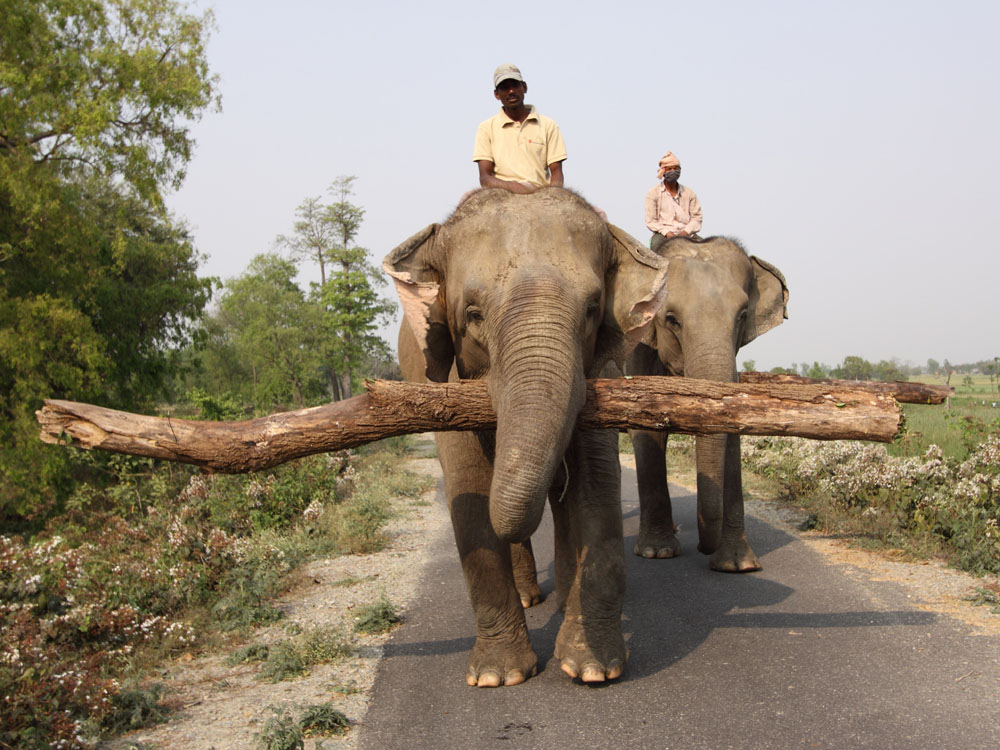
Elephants are used in this region to carry heavy loads. Shortly after I took this photo our jeep was swept off the road!!


Asian elephants carrying logs.

On our last evening at Koshi camp we witnessed a powerful storm which blew up in late afternoon. Fortunately, we were actually in the camp exploring the lagoons. We were able to run back to the dining room before the storm really got going. We quickly closed all the windows. Just as well, as the storm whipped up a lot of dust and sand from the dry bed of the river and carried it all over the camp and further afield.

Next stop: Chitwan nature reserve far to the West of Koshi
 
PS. I was joking about the elephants and our jeep.

TBC.