Monday, 2 October 2017

Madagascar 2 - Antsirabe - Ranomafana National Park


The next day we started back towards Antananarivo, the start of a journey which effectively lasted 2 days until we reached Ranomafana.  On the first day, the journey was punctuated by a stop at a centre housing a good collection of chameleons, geckos, frogs and butterflies. We were able to get really close to them.  They were in large enclosures, and chameleons are quite slow moving in any event. I'm afraid I haven't identified them yet.


Chameleon - unidentified as yet


Chameleon - unidentified as yet


Chameleon - unidentified as yet


Chameleon - unidentified as yet


Chameleon - unidentified as yet
We also saw some amazing geckos, which also managed to camouflage themselves against their background so as to be almost invisible.

Leaf-tailed Gecko - about 25cm long


Leaf-tailed Gecko - about 25cm long


Leaf-tailed Gecko - the eyes have it!


Where's Wally?? - the gecko is there somewhere.
Millepede making for a hand - not mine!
One of the nice things about having a guide with us, was that on the long journeys Rija would, periodically, entertain and instruct us about the local tribes, customs, history and activities. There are 18 tribes in Madagascar, each with their own language.  The language of the tribe around the capital was officially adopted as the Malagasy language, but there are still some places where communication between Rija and the locals was not straightforward.  The majority of the population still lives and works in the countryside.  More people in the city go to schools, but overall literacy is probably about 60%.  Most people understand some French.  This was handy, as I could get by with my basic French.

We also got off the bus occasionally and walked around the villages. In this way we could see, close up, some aspects of their daily lives.


Typical village street market


Market in a larger village/town
Getting around in Madagascar

With no railway and the hilly terrain, the only way to get around is by road. Walking is most common. Zebu carts are everywhere.


The ubiquitous zebu cart


For long distances, there is the car, taxi or sometimes Italian-made tuk-tuks (motorised rickshaws).  Then there is the taxi-bus. These overloaded buses ply the country, some long journeys taking several days.  They didn't look too comfortable; hot and overcrowded. Here is a typical one:


Typical taxi-bus
We ended the first day's journey in Antsirabe, staying overnight at a nice, red-brick hotel called Les Chambres du Voyager. We only really had time for dinner before going to bed, but I asked one of the staff whether there were any birds around in the garden, which had a large pond with a small accessible island.  He said the best time was from 05:30 to 06:30.  Three of us agreed to get up to see what was about at that time.

I rose early, dressed, and by 05:30 I was in the garden, where I met Sian and Nic. What fools! It was still dark for goodness sake!  There were indeed many birds that started to appear at first light, including common jery, Madagascar Fody, a Madagascar Malachite kingfisher and Madagascar white-eye. A hamerkop flew overhead, and there were a few other birds which it was too dark to identify.
Common Jery


Madagascar Fody


Madagascar White-eye
After breakfast we set off towards Ranomafana.  Thoughtfully, Exodus had again arranged to break the journey with a stop in Ambositra, the centre of Madagascar’s woodcarving industry. Most of the wood carving is done in an area in the mountains a little way from our route, so we went to an artisan paper making factory instead. There we also did some shopping!


Artisan paper making.
The wet sections are set to dry in the sun
After lunch, we pressed on. The countryside is full of family tombs of different sizes. Typically, the body is buried or entombed temporarily to allow the body to decay. After about ten years, the body is exhumed and the bones are reburied permanently in a ceremony known as "the turning of the bones". Some of the family tombs look like small cottages and are in lovely positions. Here is a typical one:


A family tomb by the roadside
This is the beautiful valley that it overlooks:
Rice paddies on the terraces above the river

Finally we made our way to Ranomafana, arriving at our hotel, Le Grenat, in the late afternoon.  As we would be staying at this hotel for two nights, we decided to have all our dirty clothes washed.  They all came back nicely laundered at a very reasonable price.

The next day we visited the Ranomafana National Park.  Again, we had local guides, called Diamondra and Tsilavo. This visit was a great adventure into the rainforest, home to the Golden bamboo lemurs, a species critically endangered outside the North. The park was formed by the government after these lemurs were discovered there in 1986 by an American anthropologist, Dr Patricia Wright.  We had to make our way through quite dense undergrowth to where the lemurs were feeding. 


Golden Bamboo Lemur at Ranomafana National Park


Golden Bamboo Lemur at Ranomafana National Park

The guides could see that I was interested in birds. I asked whether there might be a chance of seeing a Madagascar pygmy kingfisher.  Later on in the visit, they took us to a place where there was indeed a pygmy kingfisher. Fantastic!  We had now seen both the kingfisher species of Madagascar.


Madagascar Pygmy Kingfisher - a forest species that doesn't eat fish!

As we were leaving the National Park, I saw a Madagascar bulbul very close and in a nice position.  It's a very common bird, but I decided to take a careful photo of one.  I often neglect the most common birds in favour of the rarer ones. When I get home, I then realise that I don't have a decent photo of some of the common birds.


Madagascar Bulbul

For lunch, Rija had booked us into a local restaurant.  We were on the terrace, in the shade and overlooking a valley. Perfect!  In fact, we saw very few birds during lunch.  Bird activity is low in the middle of the day.  However, walking back to the hotel we saw a couple of kestrels.  The Madagascar kestrel comes in two morphs; dark and pale.  The dark morph is similar to our common kestrel. The pale morph is a very handsome bird indeed.


Madagascar Kestrel - dark morph


Madagascar Kestrel - pale morph
After lunch, some of us decided to wander around the village and then look for the spa fed swimming pool which was somewhere over the other side. We went to the local post office and bought some stamps for postcards, had a wander up the main street, and then ambled towards the swimming pool, asking directions in French.

On the way, I took some photos of some mascarene martins.


Mascarene Martin
To get to the swimming pool we had to cross the river. The original bridge, a substantial steel structure, had been swept away at some point by higher-than-normal monsoon floods. This bridge had been replaced by a new one, partially suspended from the superstructure of the old one by some simple twisted steel wire. 
New from old. New bridge suspended from old structure.
We found the swimming pool, but didn't go in. Lynne wanted to paddle in the warm water of the hot springs nearby.


Happiness! - Lynne paddling in hot spa water

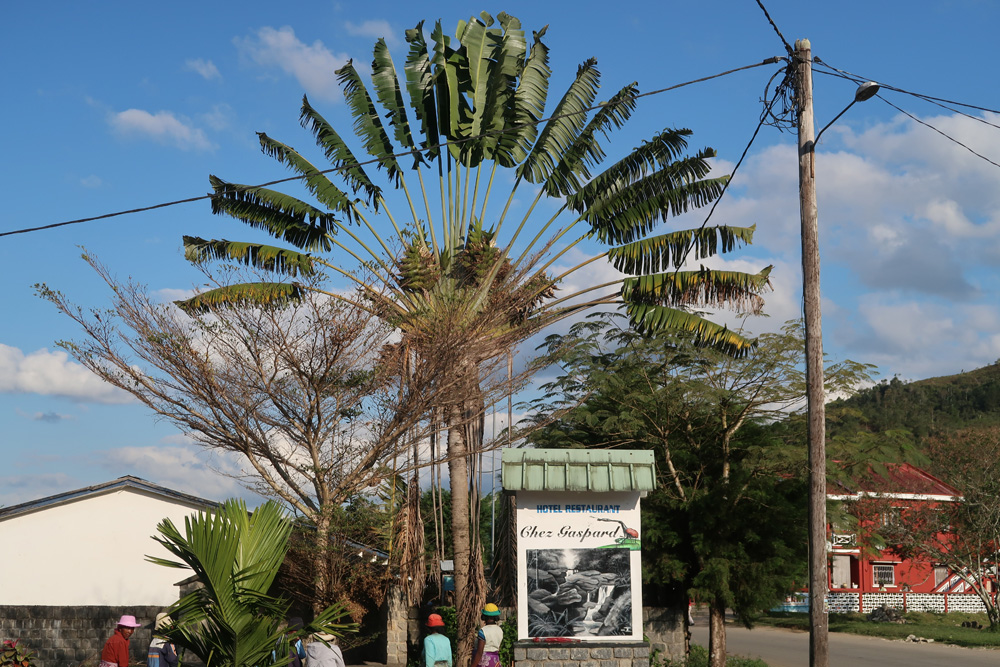
We wandered slowly back to the hotel, passing a magnificent traveller's palm tree.

Ravenala or Traveller's tree at Ranomafana

At Le Grenat, we had a gin and tonic before dinner.  Chris reported that there was a large moth on the wall outside his room. We went to investigate. We found the largest and most impressive moth I have ever seen. I learned online that the comet moth only lives for a few days.


Comet moth - huge! and lives for only a few days!
Rija gave us another briefing about our next long drive the following day, to Ranohira. We would stay for 2 nights there, our base for our visit to Isalo National Park.


Monday, 25 September 2017

Madagascar 1 - Antananarivo, Andasibe, Antsirabe


I had wanted to go to Madagascar ever since David Attenborough mentioned that 80% of all the wildlife there is endemic. i.e. you can't see it anywhere else!

We went there in August 2017 on a generally wildlife themed holiday run by Exodus. In addition, I was hoping to see some birds, but I didn't really have much idea of what I would see. If the holiday had been specifically for birds, then Lynne, my wife, would not have gone!

The worst part about the trip to Madagascar was getting there. We had an overnight flight from Heathrow to Nairobi on Kenya Airways, arriving at about 0500.  Our onward flight was six hours later, although the plane was slightly delayed, so it was nearer 7 hours!  Nairobi airport is not the most comfortable to spend a long stopover, especially as I had not slept during the overnight flight.

The flight from Nairobi to Antananarivo had a woman pilot and co-pilot! How cool is that! We arrived in the capital, Antananarivo, mid afternoon, and were met by the Exodus rep, and our guide for the trip, Rija. She advised us to change money at the airport.  As there were two of us, I changed £500, and was instantly almost a double millionaire! The banknotes are not as bad as the Gambian ones but you do get a lot of them.

After 20 hours travelling we were glad to get to the hotel; the Belvedere in midtown Antananarivo. We had a beer on the terrace overlooking the capital as the light faded, and met up with most of the rest of the group for dinner.

The following morning the entire group of nine were united - Me (Phil) and Lynne, Chris and Al, Mike and Sian, Nic, Steph and Norma.  I have to say that it turned out to be a very friendly group. The ages ranged from 35 to 89! Yes, you read that correctly: 89! Norma, an active Australian woman, was indeed 89, but did everything that everybody else did, and more. Amazing!

After breakfast, we headed off by bus to Andasibe, to the East. It's near Moramanga, but isn't shown on this map. The arrow indicates approximately where it is. For reference, here is a map of our whole trip:


Madagascar - part. Showing our journey.
Now, I ought to tell you a few general things about Madagascar. The first is that 70% of the country is Highlands.  Antananarivo is at nearly 1300 metres above sea level and Andasibe is nearly 1000 metres above sea level.  It was fairly cool when we arrived at the charming hotel where we stayed for two nights: the Feon’ny Ala hotel.  It was dusk on the balcony overlooking the small river. Nic had noticed a striated heron in the gloom:

Striated heron at dusk
The communal areas of the Feon’ny Ala hotel were very pleasant, and our room was too. The only problem was that the running water, apparently from tanks, had a very unpleasant smell to it. Our bed had mosquito nets, but we probably weren’t at any great risk at this time of year, as it was still the end of winter and not the rainy season. Nevertheless, we used them!
Typical hut at the Feon’ny Ala hotel 
The tour was for bed and breakfast accommodation only.  We had to buy our own lunches and dinners.  The price of meals in Madagascar was very reasonable, even in the tourist hotels where we stayed.  A bottle of beer of 650 ml was about £1.50.  A main course was £5 or £6 and a dessert might be £1 or £1.50. Coffee or tea was perhaps 50 or 70 pence.

Our first activity was a night walk on the road outside the nearby Perinet National Park to find nocturnal lemurs, chameleons and geckos. Guide was Saholy. We had all brought our head torches and our guide skilfully found mouse lemurs, geckos and chameleons of various sizes. Here are some of them:
Goodman's mouse lemur

Spider

A chameleon roosting

Short-nosed chameleon

Frog - Heterixalus?

Frog - Boophis?
29 August 2017  -  Andasibe/Perinet National Park - Guides Saholy and Flore

The following day, after an early breakfast, we made our way to the Perinet National Park. We had a quick look around the entrance area while the guide was buying our tickets, and found a few birds.


Crested drongo

Red-tailed vanga

Madagascar wagtail
 We set off in search of lemurs and other wildlife.  Our guides were very knowledgeable, not only about the mammals, but also the plants.  We learnt about the Travellers tree which is widely used to make houses and thatch the roofs, the palm tree that was used to make blow pipes, and the toilet paper plant!

We saw Eastern grey bamboo lemurs, common brown lemur, a sleeping weasel sportive lemur as well as Eastern woolly lemurs.


Eastern Woolly Lemur
Weasel sportive lemur
Finally, we met the most impressive lemur, the Indri.  Indri are the largest of the lemurs and the ones with the loudest and most impressive song.  Here is the Indri:

Indri - largest of the 100 odd species in Madagascar

Indri singing
And here is 20sec of the song:


This recording was made quite close to the Indri.  Heard from further away, the song tends to echo through the forest, and takes on an eerie quality.  It reminds me of whale song, or an out of tune oboe!

During our wandering through the rain-forest, we discovered two groups of Indri. Finally, our guide led us to a group of diademed sifaka lemurs, which many believe are the most attractive.  See what you think.


Diademed Sifaka

Diademed Sifaka
We saw several other species of bird in the rainforest. Photos of some of them appear below.
Cuckoo-roller
Madagascar Blue pigeon
We returned to the hotel for lunch.  From the terrace overlooking the river, we saw several other birds.

Mascarene Martin

Madagascar Buzzard

Madagascar Coucal

Madagascar Green Sunbird
Here is a green day gecko on the nearby travellers tree:
Green Day Gecko
Up to now, we had only seen lemurs in the wild.  After lunch we visited Lemur Island, where some species of lemur are held. They are free to roam without being in cages, but they are restricted to the island. They were quite used to visitors and eagerly came forward.  They were not troublesome as some monkeys are in some countries.  They could, with banana, be coaxed to sit on your shoulder.  Only the common brown lemur and the black and white ruffed lemur would sit on your shoulder. Other species kept their distance.

Phil with Black and White Ruffed lemur

Lynne with Common brown lemur (and Nic over her shoulder)

Norma with Common brown lemur

Steph with Black and White Ruffed lemur
I also saw a Madagascar swamp warbler on the island:
Madagascar swamp warbler
This visit was quite fun, in the sense that we got close to one or two species.  When they sat on your shoulder and touched your skin they had no claws.  Their fingers were actually very soft.

We had a very long canoe ride to get to the island, in boats like this!
Chris and Rija in canoe
On our way back to the hotel, we went through the village of Andasibe.  It had a railway station, but the limited railway no longer functions much in Madagascar. There are only two unconnected networks, originally built by the French.  The track has not been maintained. There are some goods trains that run infrequently.  A passenger service runs from Fianarantsoa to the East Coast.  This is all quite surprising in a country that is so big (over 1500 km long and nearly 600 km wide).  

Getting around takes time as there are only a few major roads.  There are no motorways or dual carriageways.  The main roads through the hills are winding. Journeys take a long time.


That evening we enjoyed some drinks and dinner in the hotel before getting an early night.  We had quite a long drive ahead of us in the morning – to Antsirabe.