Monday, 19 November 2012

Ecuador – Part 4

Ecuador – Part 4. Heat at last, formula 1 canoes and the highest tree house in the world (so far)!

The flight from Quito to Coca was short but the difference in terrain and temperature was staggering. The deep clefts in the earth in the mountains around the capital gave way to the flat, bland aerial scenery of the Amazon basin around the river Napo. We landed and the heat hit us as we ‘de-planed’. Well, we got off!
Roadside hawk
I like that in Ecuador, when you leave the airport terminal with your luggage, you have to show your luggage counterfoil to prove the case is yours. Can you imagine them doing that at Heathrow?
Lesser kiskadee - a type of flycatcher
We were heading for Sacha Lodge, a holiday ‘resort’ with an amazing organisational skill as we realised when we got there. Their representatives greeted us at Quito airport before we even got on the plane, took our details, gave us our room numbers and tagged our luggage which we didn’t see again until we got to our room!
Crested owl

On landing in Coca we were met by a bus, entertained at their own basic but welcome facility where we could have a coffee and a snack while they loaded the luggage onto the first canoe. It’s about 70km (44 miles) to the first stop. How long would it take? Here is a canoe very like ours (this one is at our destination, Sacha Lodge Boat Dock):
A motorised canoe
What you can’t really see are the two 75 horse-power 4-stroke outboard motors at the back. They boarded us all carefully, distributing the weight evenly. The canoe pootles out into the river, turns to point the right way and then they open the throttles - like this!


The turbo canoe ride! Wheeeee!
Well, I’m sure everyone was surprised at the speed and we did the whole trip in 1h 45m, almost never slowing despite some perilously shallow looking water. The dry season had been very dry and the river level was low. That’s an average speed of over 35 Kph. Pretty fast for a boat.
Collared inca - a hummingbird.
It was exhilarating for the first 5 minutes, then you realise everything’s going by too fast to take anything in so you sit back and try to fall asleep, hoping the journey won’t take too long.
Cocoi heron on the Napo river
On arrival at a mooring in the middle of nowhere, we then had a 2 km walk through the rain-forest followed by another, more leisurely, canoe ride across the lake to the wonderful Sacha Lodge. All you could hear was the sounds of the rainforest. There isn’t a road or anything for at least 50Km. Bliss!! 
Rufescent tiger-heron


To give you some idea how isolated this lodge is, open Google maps, cut and paste (or type) the words "Sacha Lodge Boat Dock, Sucumbios, Ecuador" (without the quotes) into the search box and press 'Enter'.

The 'Sacha Lodge Boat Dock is where we got off the Motor canoe. From there you can follow the path to the East (right through the forest to the 'Canoe Dock'. Here we boarded the small canoe for the trip across the lake to the Lodge itself. Then if you zoom out you can see the nearest road to the East about 50Km away.

Green and rufous kingfisher
Although completely isolated from the rest of civilisation Sacha Lodge had a bar where cocktails, gin and tonics, etc. were to be had. So we had!


Jörg, Lynne and Oscar, our guide at Sacha Lodge.
We had dinner with Oscar, our guide for the next 4 days, and then went to bed, ready for, you’ve guessed it, a very early start. Our wake-up call came at 05.00 followed by breakfast at 05.30 so we could get into the canoe at 06.00.
Russet-backed oropendolas mating
We were heading for the tree-house! A lovely canoe ride through the mangrove channels preceded a short walk to the base of the tree-house built around an enormous kapok tree.
The tree house from the ground
The main platform was 40m (131 ft) high and even at that height, the trunk was still about 2m in diameter. From here we towered over the rainforest canopy.
In the treehouse. Note size of branches even 40m up!
As the sun rose and the light improved we saw an amazing range of birds that morning. Some were distant but most were nearby, often in the branches of the same tree. It was a fabulous way to start the day.
Opal-rumped tanager
Paradise tanager
Golden-collared toucanet
After lunch Lynne and I decided to brave the Caiman infested waters and go for a swim. The water was cloudy black in colour so you couldn’t see what was sneaking up on you! Fortunately, we lived!


Lynne in the caiman-infested lake. She lived!
Although caimans grow to be as large as crocodiles they are vegetarian. This is a baby one I filmed right where we swam and I did see a few others that were 3-4m long out towards the middle of the lake.

Small caiman in the lake
Bugs were everywhere. After trying at first to get them out of our room we accepted the inevitable and didn’t worry too much. Even Lynne got rather blasé about them. Here are a few cockroaches, stick insects, moths, etc. The hands/fingers included for scale are Lynne’s!
A handsome locusty thing.
UFB (unidentified flying bug)!
One of a few cockroaches in our room.
Hand-sized. This is only a moth!!

Stick insect on the bed.
The whole area is/was a heavy oil producing area (not that we saw much evidence of it). Jörg, who works in the petroleum industry, pointed out that the foundation structure of the dining room, kitchens, etc. was all made from old oil-drilling pipes. Well, it is at least recycling.
Black-headed parrot.
The buffet food was good and, even when we went for breakfast at 05.30, the breakfast items (even cooked dishes) were there already!

Going down the stairs of the treehouse
In the late afternoon, when the midday heat had died down, we went for a walk in the rainforest or a canoe ride in the swamps. This was very peaceful and relaxing.   On one of these canoe rides we first met the hoatzin, an amazing and strange bird.
A hoatzin
The following day we visited the river islands of the Napo. These are the sand islands that form in the middle of the river so they are only reachable by boat.

White-banded swallow
We visited a parrot lick – a place where parrots lick salt at an exposed mud cliff where salt is available. This helps supplement the parrots’ diet.


Yellow crowned Amazons (parrots) at the clay-lick
Greater yellowlegs

Lunch in a local wildlife reserve was followed by a tour through the forest looking for more birds.

White-winged swallow
On the third day we were up in time to have breakfast, do a moderate walk through the rainforest and climb the tower to the aerial walkway through the forest canopy in time to see the sun rise!

Waiting for sunrise on the aerial walkway

Half the span of the aerial walkway
For some, it was scary. The walkway is nearly 40m high and is rather exposed. Lynne coped very well!

Crimson-crested woodpecker
We saw the sun rise and noted several new species, including a nesting pair of double-toothed kites! On the wire he looks like a raptor:

Double-toothed kite on the wire
On the nest, however, it looks rather like a pigeon!

Double-toothed kite on the nest
Greater yellow-headed vulture

We enjoyed another long canoe ride through the channels before the final barbecue on the eve of our departure and then it was all over!

The fabulous long-billed woodcreeper!
Chestnut-collared swift
A quick final birdwatch on our way to the Formula 1 canoe and we were on our way home.


Oscar (guide), Lynne & Phil as we were leaving.
2 hours on the turbo-charged canoe, flight to Quito, overnight stop at the same hotel, trip to the airport and we were off. We had 3 flights back home and it took 24 hours from the time we left the hotel in Quito to when we arrived at our front door. Phew! Sleep at last! Well, not quite, because Phil had to go to work in the afternoon!

Other parts:

Ecuador - Part 1    
Ecuador - Part 2    
Ecuador - Part 3


Monday, 5 November 2012

Ecuador – Part 3

Ecuador – Part 3.  Altitude sickness sweets at over 4 times the height of England’s highest mountain.
After the brief overnight stay in Quito we left before dawn and made our way to an area on the outskirts of the capital. This yielded giant hummingbird, scrub tanager and sparkling violetear (another hummingbird).
Giant hummingbird - female

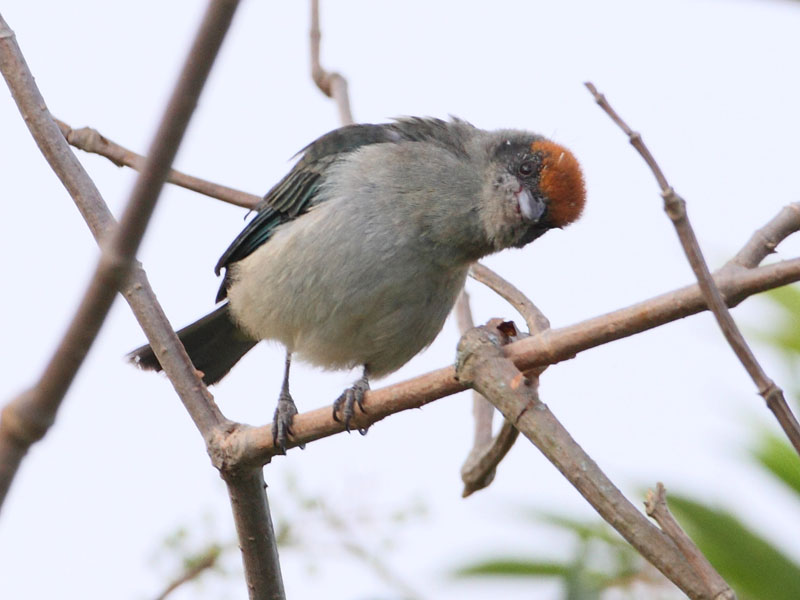
Scrub tanager


Sparkling violetear. It doesn't really have a rusty throat; it's just pollen!

Eared dove
We moved on to another suburb nearby, seeing hooded siskin, vermilion flycatcher, eared dove and southern beardless tyranulet among several others.
Hooded siskin
Much of the rest of the day was spent travelling, with the odd stop. We climbed higher and higher up the mountains. It got colder and colder with strong winds but glorious sunshine. Despite this, the sun shone and it was so clear that, from our viewpoint, it was possible to see all the major peaks and volcanos clearly. These included Antisana (5,704m), Cayambe (5,790m), Cotopaxi (5,897m) and Chimborazo (6,267m). Gustavo told us that this was very unusual. He couldn’t remember a time when it was clear enough to see them all!
This volcano is Antisana - 5,704m
We arrived at the summit of the mountain just below the tangle of aerial masts, cables, satellite and microwave dishes and the small military hut. We put on all our warm clothing. Fortunately, Birdfinders had warned us of the likely conditions.
At 4,368m. (photo by Jörg Schmitz)
Our target birds were very hardy indeed. We were at 4,368m above sea level, over 4 times the height of England’s highest mountain. The rufous-bellied seed-snipe, bar-winged cinclodes and Paramo ground-tyrant are birds which are generally found only above 4,000m. There was not much vegetation and what there was grew very slowly.
Typical plant life at over 4000m
This isn't surprising as there was ice in the sheltered spots that didn't melt in the 'heat' of the afternoon.
Icicles hanging off the plants at 4,200m
Lynne decided to stay in the van while the rest of us climbed the 100 vertical metres to the very top and over the adjoining hills in search of our quarry. Climbing or hurrying was fatiguing at that altitude due to the lack of oxygen. We got out of breath easily. Gustavo gave us some ‘coca’ sweets to combat altitude sickness. I observed that they were made in Peru and something made me doubt that we could get them in England!!
Plain-capped ground-tyrant (until recently called: Paramo ground-tyrant)
We saw Carunculated caracara, Paramo ground-tyrants  (now called Plain-capped ground-tyrant) and bar-winged cinclodes (now called chestnut-winged cinclodes) but, in the 2 hours we searched, the seed-snipe remained elusive.
Chestnut-winged cinclodes (until recently called: bar-winged cinclodes)
We went back towards the van where Gustavo talked to the soldier on duty. It seemed that the birds had been near the summit by the upper masts earlier in the day but he hadn’t seen them since then.
Ah, Well! Win some, lose some! We decided to go. The others moved back to the van. I had one last scan of the summit with my binoculars. After only a few seconds, there it was! Rufous-bellied seed-snipe!! I yelled “Gustavo, Gustavo!”. Everyone returned to see it and we climbed up to the top again for some really good views of this rare bird.
Rufous-bellied seed-snipe. Found in the nick of time!
We pressed on, making a little excursion to a high lake for distant views of Andean coot, Andean ruddy duck. We then carried on to slightly lower altitudes until we reached the village of Papallacta at about 3,300m. Here, at the trout farm pools we saw Andean gull and Andean teal.  Our overnight stop here was at the Termas de Papallacta. This is a spa hotel where there is a warm spa pool literally outside every room. We quickly changed into our swimming costumes and waded into the warm water to relax before a welcome dinner and a good night’s rest.
Termas de Papallacta, just outside our room. Lovely!
Another early start the following morning before breakfast found us higher up again on the trail above Papallacta for other high altitude (Paramo) birds. These included grass wren, shining sunbeam (hummingbird), tufted tit-tyrant (yes, really) and scarlet-bellied mountain-tanager.
Shining sunbeam - another hummingbird
Scarlet-bellied mountain-tanager
During breakfast I had to go outside to take pictures of a lovely spectacled whitestart in the garden.
Spectacled whitestart
After breakfast we toured the grounds of this lovely hotel finding many new birds.
Great thrush
Rufous-breasted chat-tyrant
After lunch we were off to pastures new. On the way we saw the feisty torrent duck. It is aptly named as it frequents really fast flowing torrents, hurling itself beneath the swirling white water and managing to jump out again in the same place!
Torrent duck. This is the male. The female was just as corageous!
Jörg, Gustavo, the guide, and Lynne on the bridge overlooking the torrent duck.
Eventually we arrived at our new overnight lodge at San Isidro, fairly remote but set in lovely grounds. A short stint at the hummingbird feeders and on the viewing terrace brought several more useful hummingbirds such as chestnut-breasted coronet, collared inca and bronzy inca, as well as the gorgeous Inca jay. Yes, I know it’s a member of the crow family, but it’s still a very handsome bird!
Chestnut-breasted coronet (yes, another beautiful hummingbird)
Inca jay
We were the only group at San Isidro Lodge so the service at dinner was excellent. I was up at dawn to see the birds picking the insects off the lamp post.
Common bush-tanager with one of the bugs off the lamp-post
Lynne stayed in bed until breakfast at 07.05. Can you imagine such indolence on holiday?
After breakfast, we went to see a white-bellied antpitta which one of the men had managed to train to come out of the undergrowth briefly. That is amazing for such a shy bird.
White-bellied antpitta
We worked the gardens and the surroundings of San Isidro Lodge until early afternoon. On the road again, we stopped at Guango Lodge for coffee and another batch of hummingbirds. One of these was the magnificent sword-billed hummingbird. Nothing can really prepare you for the sight of such an enormous bill!!
Sword-billed hummingbird

Sword-billed hummingbird
After coffee it was back to Quito for another overnight stop before our flight to the Amazon basin for the final part of the trip. This heralded a region much closer to sea level, with new birds and, above all, warmth. Even though Ecuador is on the equator, at the altitudes we had been so far, we hadn’t known any real warmth (except from the lovely people, of course).
Ecuador - Part 1
Ecuador - Part 2
Ecuador - Part 4
 

Monday, 15 October 2012

Ecuador Part 2

Ecuador tour – August 2012 – Part 2.


Hummingbirds, tanagers and more

hummingbirds! . . . and still cold!
Sachatamia Lodge was high on a hill. It was an impressive timber lodge with a very cosy bar/dining-room and fairly distant, well-spaced chalets for guests. Each chalet was surrounded by forest. There wasn’t much lighting away from the dining room/bar; just the odd, weak lamp.

Golden tanager


Halfway to the bar once, well before dawn, in near pitch blackness I had to return to the room to get something. I left Lynne to carry on to the dining room. I was quick, and I was surprised that Lynne had managed to get so far ahead of me without a torch! She wasn’t at the bar so I retraced my steps to find her almost in tears after she had taken the wrong path! Here is our chalet:
Our chalet at Sachatamia Lodge

And a carved wooden ‘Yumbo’ hunter outside the bar:
A Yumbo hunter at Sachatamia Lodge

It was still pretty cold at this altitude, even at the Equator! Survival depended on being well tucked up in bed each night!!
Our first morning at Sachatamia involved getting up before 06.00 and being ready to start at 06.30. The carpark had a strong light that burned all night, attracting many moths and other insects which landed and stayed on the main pole of the light and on the surrounding bushes. At dawn, birds would come to feast on the unsuspecting insects. 
Red-eyed vireo
After breakfast we drove to various places/reserves. We had morning coffee in a café with a lovely garden where fruit was left for the birds.
Green thorntail (a hummingbird)
There was also the obligatory battery of hummingbird feeders. It was really relaxing. Drinking coffee and watching all manner of hummingbirds, tanagers and other birds. What could be better? The tanagers are a large group of colourful birds. I love them!
Brown violetear (another hummingbird)
Here is the 'café' called Jardin de Orquideas (Orchid Garden):

Café 'Jardin de Orquideas'
Next day was spent entirely at Milpe, at a very productive nature reserve.
Lemon-rumped tanager
We never got up later than 06.00 and sometimes it was an hour or two earlier depending how far we had to go! Certainly, every day involved a very early start so I won’t bother to mention it each time from now on!
Swallow tanager
We didn’t mind these early starts (well, I didn’t mind; not sure about Lynne) because until we got used to the time difference we found ourselves awake by the small hours anyway. It was no big deal then just to get up!
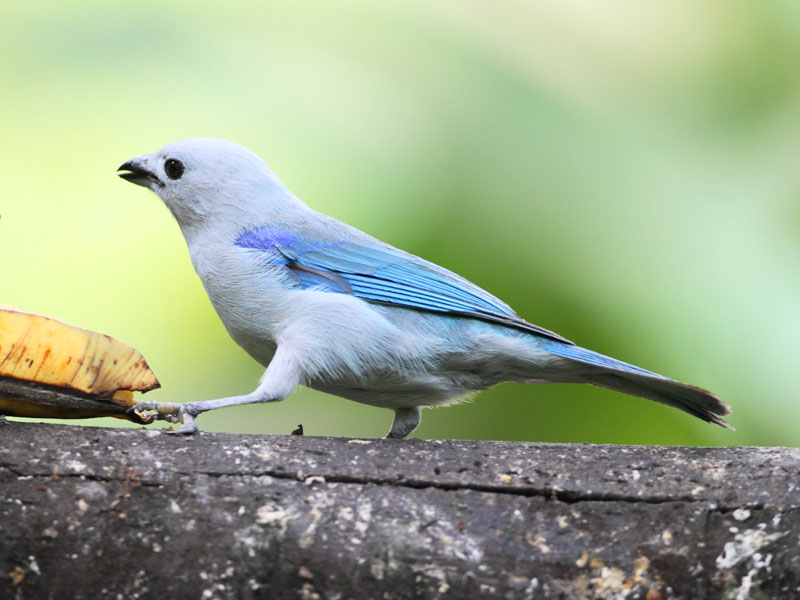
Blue-grey tanager
More early-morning birdwatching around the lodge on Sunday before setting off for Quito again for the night.
White-whiskered hermit (another hummingbird)
En route to Quito, we went in search of the rare ‘white-tailed shrike-tyrant’. (Most of the birds here have really long names!) This involved a long walk and a climb up the foothills, forcing our way through thorny bushes. Lynne, sensibly, stayed back. I went most of the way but stayed behind when the others pressed on, further along the ridge.   I enjoyed the solitude of the place, and, in the calm after the others had left, I noticed a burrowing owl sitting on the dry branch of a nearby bush. 


Burrowing owl

My comrades had pushed another couple of hundred metres along and they called and gesticulated to me. I went to join them and saw the shrike-tyrant further up the hill. It was rather distant, so the photo is not too good.


White-tailed shrike-tyrant

We went back to the same hotel in Quito for a relaxing shower, a very pleasant evening meal, a lovely bottle of red wine – followed by. . . . .  another pre-dawn start!

Ecuador - Part 1
Ecuador - Part 3   
Ecuador - Part 4

Saturday, 6 October 2012

Ecuador Part 1


Ecuador tour – Part 1 – August 2012.


1.      Long flights, lost luggage, freezing cold (yes, even at the equator!)


We started well from Heathrow after the taxi dropped us off. A long flight to Miami, followed by one to Quito, where, after delays, we arrived at 23.30 on Tuesday 31 July, dog tired. We waited for our cases, which didn’t appear, though many of the locals had trolleys piled high with 6 or 8 really large cases. We were really worried as we had never lost any cases before, but, as we made our claim to American Airlines and spoke to others, it became clear that non-arrival of luggage was commonplace. They simply didn’t have room on the plane for all the cases.
Giant antpitta
We had only the clothes we stood up in, and I had only flight socks (those knee-length, tight socks to prevent blood clots). At 00.30 we left the airport, relieved to find that our taxi driver had waited for us. We were soon at the hotel and asleep. We were woken by a call at about 5.45 from Gustavo, the guide, inviting us down to breakfast. He thought our cases would turn up in a day or two! In the meantime, I had no tripod, and neither of us had anything else! It was quite unsettling. However, as we made our way to the Bellavista Lodge in the cloud forest, all worries about lost suitcases were temporarily forgotten!


Red-headed barbet

Quito is about 2,800m high so it wasn’t that warm. Just as well! At least we didn’t sweat very much and start to smell!

Andean condor
Our group was small, only 5, plus Gustavo and our driver. It was a nice number for birdwatching. Too many and those at the back of the group often arrive too late to see a bird.
Great saphirewing

We drove out of Quito, stopping occasionally to search an area for birds. One of the rarest on the first day was the Andean condor which we were lucky enough to see in flight on the first morning. Photographically, those first two days were frustrating. I had my camera, but no tripod! I had my battery charger but no cable! Hand-holding a camera weighing 5.5Kg isn’t easy for more than a minute or two. Keeping it still to take a picture is even harder.
Here we are on a high mountain path in the Andes
Bellavista Lodge was also high, at about 2,300m in the Tandayapa Valley, about 2 hours North West from Quito if you took the fast route. We took all day, naturally. This map shows where the reserve (coloured green) is in relation to the capital:
Bellavista Lodge (in green) high in the Andes
The Lodge was quite remote and natural. Our room was basic but attractive. We both had a shower and dressed again in the same clothes before going to dinner. The cloud forest lived up to its name and it rained quite a lot. One of the receptionists lent me a cable so I could charge my camera battery. Gustavo rang American Airlines. There was only an answering machine. Gustavo told them we were leaving the following afternoon and that if they didn’t send our cases soon, they would have to deliver them to somewhere much further away!! It was true.
Our room at Bellavista Lodge
On Thursday 2 August, we woke at 5 and left at 5.30. This was to be the pattern for the whole holiday. We had a packed breakfast and spent the morning birdwatching around the lodge. This was very enjoyable and took our minds off the subject of cases. As soon as we stopped and came back to the lodge for lunch, the thought of having to manage without our luggage loomed large again. Fortunately, while we were out that morning a taxi had arrived from Quito with our cases. We were over the moon! We had a shower, changed into clean clothes, I assembled my tripod and we went out twice as happy as before lunch. What a relief!
Dining room at Bellavista Lodge
We then loaded the van and made our way to another high area, Sachatamia Lodge. We arrived as darkness fell but there was enough light to see that this was a haven for hummingbirds!


Ecuador - Part 2    
Ecuador - Part 3
Ecuador - Part 4