Tuesday, 27 September 2011

Better luck with pallid harrier in Sussex

Although I did see the pallid harrier at St Osyth in Essex, I wasn't ready when it flew up and got no pictures. The bird flew off and was never seen again.

Today (26 Sep) Mark Stanley and I went to Pagham and called in at Burpham on the way. The juvenile pallid harrier was very obliging and made several passes over a strip of uncut grass/crop down the centre of a large field. The field is on the right as you approach the village.

Pagham was OK, with the usual mix of waders, the highlight being an extremely pale almost albino curlew.

After lunch we headed back to Burpham where the sun had moved more behind us. The bird was still there and made a few more flypasts before I had to leave to get back in time for my rehearsal.
Juvenile pallid harrier

Juvenile pallid harrier being
mobbed by a sparrowhawk.


Sunday, 21 August 2011

Sabine's gull hangs around for us in Dorset.

I haven't been twitching for many a month and I have missed the trips a bit. I was sceptical about a gull in Dorset, a gull which could easily fly off at any moment. David Campbell suggested waiting for news on the pager before leaving but I thought it would be best to go early and go somewhere else if the Sabine's gull didn't show.

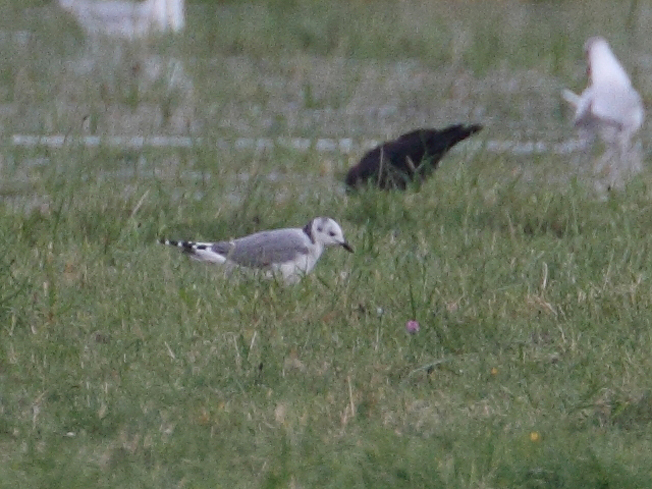
As it turned out, we saw the first winter gull about 15 minutes after arriving. It was easy to see when you had seen it and realised how different it was from the 1,500-2,000 or so black-headed gulls in the same field! It was quite distant, though it did fly over from one side of the causeway to the other, allowing the odd flight shot. I'd like to see this gull in full breeding plumage; much more impressive!

Sabine's gull - first winter

Sabine's gull - first winter

After the gull and a coffee we went to Acres Down in the New Forest where David was keen to see a honey buzzard. It was raining at first but this cleared the air so visibility when it stopped was good. David picked out a juvenile goshawk in a distant tree while I found a lovely pair of redstarts nearby.

Common redstart - female.

The skies were however almost devoid of raptors until the sun came out. We saw a few goshawks, one being mobbed by a hobby and another by a sparrowhawk!! There were a whole army of common buzzards but no honey buzzards. The sun meant that heat haze set in and made scrutiny of distant raptors more difficult. As time wore on David became more desperate, threatening dire consequences if he didn't see a honey buzzard by next spring!!

By 3.30 the skies were again largely empty, although two lovely common buzzards appeared almost overhead showing as close as any we had seen.

We wandered slowly back to the car, had tea and cake in the farm garden before heading for Blackwater Arboretum. I wanted to see hawfinches and David was hoping for crossbills which were not flying over. The arboretum, a gorgeous oasis of tranquility amid the huge conifers, produced crossbills flying over at regular intervals but denying us any good views of the birds perched. Perseverance paid off, however. Finally, we managed to find some feeding at the top of a very tall tree.

Crossbill - male

There were no hawfinches that day, but there was lots of other avian activity. A great spotted woodpecker bashed away at a very large cone while a coal tit looked on expectantly.

Great spotted woodpecker

A firecrest flitted quickly in the lower branches of a nearby tree. A juvenile common buzzard led us a merry dance, calling constantly. We thought it was airborne and that we couldn't see it only because of the tall trees. It turned out to be perched and was just calling to its mother as young birds do!!

Common buzzard - juvenile

All in all, a very enjoyable day. Thanks David.

Friday, 19 August 2011

Happy hoopoe in Happy Valley.

Went with David Campbell to see the hoopoe which had been around since Sunday on farthing down. It took about 40 minutes to find it but then it stayed around for about an hour feeding at the side of the grass track. Lovely bird, and nice to have in the area!!
Hoopoe

Monday, 15 August 2011

Subalpine warbler always 'sub' the bush!

David Campbell asked if I wanted to go for the subalpine warbler of Holland Haven Country Park in Essex.
He needed it for his British list although I had seen the, perhaps even more elusive, bird on Scilly last autumn. I've largely given up twitching this year. As a result, David has overtaken my British total and is now well ahead! I confess I have missed some of the trips.

Anyway, we decided to risk going even though yesterday it had disappeared by about 11.00.

It was showing quite often at the car park but it wasn't exactly an exhibitionist!! The odd glimpse for a few seconds as it flitted through the dense bushes was the most you got. If it did stay for a minute or two it was half hidden in the foliage. Very difficult for photography. These are the best I could get.

Subalpine warbler - male.

Subalpine warbler - male.
Yesterday David and I watched the antics of a juvenile and adult hobbies in Banstead Woods.

Juvenile hobby
Hobby - probably male as he sat there all the time doing nothing!!

Monday, 1 August 2011

Kingfishers at Sevenoaks. An anniversary present for Lynne.

Lynne likes kingfishers and hasn't seen one for 2 or 3 years. When we visited Sevenoaks wildlife reserve on Sunday we didn't see any. I thought the best way to see them was to come back as early as possible and wait.

We left at 06.20 this morning, which also happens to be our wedding anniversary. A lot was riding on this 'twitch'!! We were the first to arrive and went straight to the hide where I thought the kingfishers would come. Literally 2 minutes later I heard the familiar call and a few seconds later a kingfisher alighted on the post nearby, stayed for 3 or 4 seconds and flew off before I could get a shot!!

I set my camera up and expected to wait an hour or so for his next visit. 5 minutes later he re-appeared and I took a few shots before he dived in and came out with a small fish. This time he stuck around and shook the fishlet before swallowing it on the post. It couldn't have been better!! Lynne very pleased!

Here are the best of the shots.

Kingfisher with minnow
Kingfisher

Tuesday, 21 June 2011

Dungeness, spoonbills, small birds and a bad back!

Yesterday, David Campbell and I went to Dungeness. Weather wasn't brilliant but we had a really nice day. David wanted to see the squacco heron that was there on Sunday but the bird had flown!

While David kept a vigil for the heron at the ramp I relaxed photographing small birds near the Christmas hide. Monday being a weekday, the reserve is quiet and the birds more confiding. I was able to get really close to a sedge warbler and a common whitethroat, and reasonably close to some linnets.

Sedge warbler

Common whitethroat
A hobby flew over chasing dragonflies and eating them on the wing as this sequence shows:

Hobby. "I'm hungry! Hope there's some food soon".

"There's a damsel fly. I'll go for it!"

"Nearly there! Get claws ready."

"Gotcha!! Mmm! Lovely!"

"Right. Where's the next one?"
I joined David on the ramp from where we were treated, unexpectedly, to the sight of a pair of spoonbills which flew almost over our heads. I fired off well over 100 shots with my camera above my head and must have pulled a muscle in my back. I was in serious pain this morning! Handholding a 5Kg camera for more than a couple of frames is dangerous!! This is what caused my agony:

Spoonbill
Reed warblers flitted tantalisingly near but they are very difficult to photograph as they only hang around for a second or two. I just couldn't get a photo.

From the hide we saw a pair of common terns on the raft, mating even this late in the season.

Common terns. "I told you to sit on those eggs!"
Back at the visitor centre we nearly stepped on some very small newts, probably smooth newts, that were crossing the path.

We wandered over to the ARC pit hoping the spoonbills might have landed there. They hadn't, but there were more reed warblers! Several times I tried to get a shot without success. The reeds were thick and autofocus doesn't work in that situation. I initially had my camera on a beanbag but it's not possible to focus manually with the focus ring resting on a beanbag! Finally, I put my camera on the tripod and waited. After a couple of failures I finally managed to nail a shot of a reed warbler bringing food back to some youngsters out of sight.

Reed warbler bring food to its young.
A very enjoyable day.

Saturday, 18 June 2011

Flying lessons begin for Sutton peregrines

Now, you'd think that learning to fly from the top of Quadrant House, about 19 stories high, would be achievement enough! However, for these peregrine chicks there were lessons in soaring and diving. They will need these skills to hunt food for themselves when the parents have kicked them out! . . I mean...persuaded their offspring to seek accommodation elsewhere!

First, the male, Dad, called to the chicks while he was soaring in the modest breeze we had this morning. One of the chicks followed him up. and there was some mock hunting and diving. It was quite spectacular!

Here I am, Dad. Show me, show me!! (Male is top left, juvenile below)
OK, son. Follow me into this dive!
Here we go! Wheeeee!! (Dad is lower left, chick follows)

Tuesday, 14 June 2011

Drama at Quadrant House as first peregrine chicks fledge!

We knew it could be any day this week but when it happened, none of us was prepared for it. At about 08.30 one of the chicks, No.1 suddenly threw himself off the top of Quadrant House. Clearly it was his/her maiden flight because his feet were down awkwardly and he lost height during the brief circuit. Although dad flew with him on the approach, he didn't quite have enough height to land on the roof again. He clung for a minute or so to the concrete before launching himself again and landing on a lower tower block on the other side of the railway line. Here are some photos showing the heart-stopping sequence.


Dad (top left) shadows his chick on his maiden flight.
Unfortunately the chick is unable to gain enough height.

He clings on for dear life with his claws to the sheer side of the concrete slab

"Can't hang around here all day. I'm off!"
"This is better. I've got my legs up now and life is in the fast lane!
I think I'll head for that other building!"
"Ooops. That building is looming very quickly!!
I'd better put the brakes on"

"Ouch!! Who put the spikes there".
Shortly afterwards, chick No.2 followed suit but just managed to scramble back onto the roof of Quadrant House! Here are his pictures:

No. 2 approaches the top of the Reed Building after a short flight.
It looks as if he won't make it!

Will he?  Won't he?

Oops! Not quite high enough!
Wow! Just made it.
Later, dad patrols the skies.
We're still not sure whether there are still four chicks. The longer we can see only 3 chicks the more likely it is that the fourth one has died or flown off alone.

Watch this space for more news.

Sunday, 12 June 2011

Sutton peregrines - Sunday 12 June. Dad is active.

Rather quiet this morning. Weather was dull and calm. There was no wind to assist the youngsters. 

A squirrell chewed on a banana skin nearby:

Grey squirrell
When I arrived there were 3 chicks all together on the edge but by the time I had taken my camera out they had moved. Two chicks look at the male on the ledge below them:


"Here, Dad! Go and catch us some breakfast!!"
The male peregrine flew twice but the female just relaxed! The male brought back something both times. First it was a medium sized bird and he threw it to the chicks. The second time he caught a swift and ate it himself!!


"Right, this one's for me!"


Saturday, 11 June 2011

Sutton peregrines nearly ready to fledge!

The 4 chicks born to the peregrine falcons on the roof of Quadrant House, Sutton are in the news. They're on the front page of the Sutton Guardian this week.

On Friday, 2 of the chicks were trying out their wings while running along the parapet but the adults weren't taking much notice. They were doing the same today:


Today, the adults were more active, flying round the building and calling to encourage the chicks. This shot shows the parents. The male is on the left. He's considerably smaller than the female but the angle of this shot doesn't show the female at her full size.

Male peregrine left - female right.


Here is the female in flight to encourage the chicks. They didn't all hatch at the same time (because the eggs were not all laid at the same time) so only the first ones to hatch are nearly ready to fly. The others will take a few days longer.

Peregrine falcon - female

Peregrine falcon - female
At one point both adults went after a pigeon. The chase was very exciting for about 200 metres before the pigeon got away by plummetting into a tree!

Later the male caught a small bird (perhaps a sparrow) and dropped it to the female without landing:


I'll keep you posted as the young birds fledge. Watch this space!